Showing posts with label SAP. Show all posts

Saturday, 20 October 2018

It’s Here! Running SAP HANA in Production on HCI

Our infrastructure portfolio for SAP HANA just got stronger.

Today we have great news! Our SAP HANA certified infrastructure portfolio has grown to include running SAP HANA in production on Dell EMC hyper-converged infrastructure (HCI).

And the timing could not be better, especially if you are already running SAP Business Suite applications on Dell EMC. Just consider the momentum of SAP HANA1;

◈ Since the 2011 release of SAP’s market-leading SAP HANA platform for real-time computing, adoption has grown to 25,000 customers.

◈ With the pending end of maintenance and support for SAP Business Suite 7 applications in 2025, customers are looking to move to S/4HANA. Since its launch in 2015, licensed customers for S/4HANA has grown to 8,900 in Q2/18.
Dell EMC Tutorial and Material, Dell EMC Guides, Dell EMC Study Material, Dell EMC Certifications

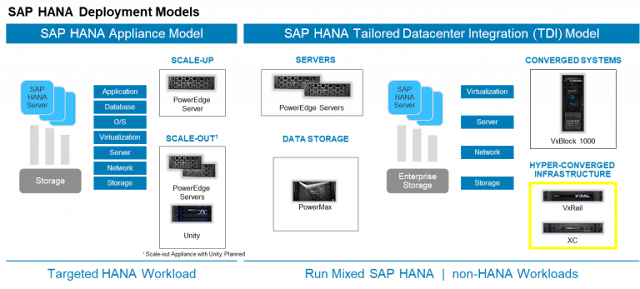
Dell EMC has partnered with SAP since the release of SAP HANA in 2011, when they announced the HANA Appliance model for targeted workloads. Since then, our portfolio has expanded for SAP’s Tailored Datacenter Integration (TDI) deployment model for SAP HANA. The SAP TDI model enables customers to lower the TCO by deploying SAP HANA as part of your shared IT model.

As HCI adoption has rapidly increased over the last few years—with 75% of deployments in the core data center2—it is no surprise that we have been increasingly asked by our customers, “What about running SAP HANA in production on Dell EMC HCI?”

Similar to our investments for Dell EMC servers, storage and converged systems, Dell EMC solutions and engineering teams worked closely with SAP to test, validate and document our configurations meeting SAP HANA performance KPIs for our HCI infrastructure.

Dell EMC HCI—in particular, VxRail— is architected to support in-memory database applications such as SAP HANA, with features such as Intel® Xeon® Scalable processors including high-memory options; Dell EMC PowerEdge servers designed for software-defined storage; next-generation future proofing technologies, such as NVMe cache drives; and powered by the leading HCI software, VMware vSAN and VMware vSphere.

Our ultimate goal is to deliver the most seamless package of HCI software and infrastructure on VxRail, powered by VMware. Specifically, SAP has certified Dell EMC VxRail P-Series all-flash (P570F), powered by VMware’s HCI software platform (VMware vSphere and VMware vSAN) to run SAP HANA on HCI for production.

VxRail P-Series All Flash (P570F) Performance Optimized System

Dell EMC Tutorial and Material, Dell EMC Guides, Dell EMC Study Material, Dell EMC Certifications

In addition to VxRail for SAP HANA running on HCI, we have even more news!

We understand that SAP provides customers choice for HCI software platforms including Nutanix. For SAP customers choosing Nutanix, Dell EMC XC Family also has achieved certification.

Dell EMC XC940xd-24 and XC740xd-24 All Flash HCI Appliances

Dell EMC Tutorial and Material, Dell EMC Guides, Dell EMC Study Material, Dell EMC Certifications

Dell EMC Tutorial and Material, Dell EMC Guides, Dell EMC Study Material, Dell EMC Certifications

With both VxRail and XC Family, Dell EMC delivers a fully engineered, hyper-converged infrastructure solution that enables businesses to innovate faster and accelerate IT operations.

Customers implementing the solution can expect the following benefits:

Dell EMC Tutorial and Material, Dell EMC Guides, Dell EMC Study Material, Dell EMC Certifications

◈ Agility―A modern SAP landscape management experience that delivers automated provisioning capabilities for SAP applications including SAP HANA and provides a faster time-to-value.

◈ Engineering―Compute, networking, and storage components that are integrated with the specified prerequisites, and dependencies that have been tested to deliver a seamless solution experience.

◈ Optimization―Design and deployment guides that highlight proven performance, automation, and resiliency best practices for SAP landscapes including SAP HANA.

If this topic is top of mind for you, I encourage you to visit the Dell EMC Booths and meet our experts at SAP TechEd 2018 in Barcelona or talk to your Dell EMC account rep today. We’d be happy to discuss the benefits of SAP HANA on Dell EMC HCI, as well as our broad Dell EMC portfolio of solutions and services that are ideal for any customers’ infrastructure needs in SAP environments.

Saturday, 16 December 2017

Driving the Next-Generation Sales Solution on SAP HANA

Analytics, HANA, IT Infrastructure, SAP

As EMC IT remains focused on its IT Transformation journey, we continue to take calculated risks in emerging technologies and adopt bleeding-edge solutions — but not without bumps along the way. However, we have found that leveraging a strong partnership with a trusted supplier is a crucial strategy to help smooth the road ahead.

Recently, EMC IT went live with the third release of its SAP implementation, replacing our direct and channel ‘selling’ tools with a suite of software products predominantly within the SAP landscape. This grouping of products – while not currently sold by SAP as a “solution” – needed strong partnership between EMC leadership and SAP, as we cooperated to string them together.

Back in 2003, EMC’s ‘selling’ tools, Direct and Channel Xpress, went live as two separate applications as a conscious choice in a very different selling model. At the time, EMC’s direct sales force was focused on high-end deals with little to no partner interaction.  But as the channel grew and the go-to-market model adapted it became clear that this (EMC+Channel) partnership needed a more tightly coupled application – one that we just couldn’t deliver with two disparate applications.

Choosing the New Solution


The core of the new application is SAP’s CRM (customer relationship management). EMC IT quickly made the decision to run it on SAP HANA database platform – our first venture  to deploy an on-line transaction processing (OLTP) platform using SAP HANA. The capabilities within SAP CRM for quoting, pricing and customer management were going to be the core of the entire system.

The next major decision focused around the next-generation product configurator. The unlimited configurability of our products and solutions is a major competitive advantage for our sales force, and EMC needed an agile tool to maintain these tens-of-thousands of rules on a daily basis.  We moved forward with a plan to use SAP’s Solution Sales Configurator (SSC) – a relatively new product with only one other production customer at the time.

It was quickly apparent that SSC’s ability to be modular and configure solutions rather than individual products matches EMC’s vision as our product portfolio continues to grow. But like all new products, there are growing pains as the application evolves. SAP stepped up to the task and directly partnered with EMC  – from senior leadership level and down – prioritizing bug fixes directly affecting EMC and enhancing the tool as we found deficiencies to our process.

The last product selected was Vendavo – a leader in the Pricebook and Deal Management space as well as a close partner of SAP.  Touting out of the box integrations, Vendavo was a natural fit for us.

Analytics, HANA, IT Infrastructure, SAP

The “Wow” Factor


With the main components selected, the focus quickly turned to user experience. Ensuring ease in selling EMC’s products would make the salesforce more efficient as well as help our partners choose to sell EMC instead of one of our competitors.

Our first user-experience step was to enlist the help of SAP’s Custom Development organization to help build a tool to easily create standardized UI’s on top of our complex product configurator. Using SAPUI5 technology and partnering with the SSC product team, SAP delivered a robust tool that allows the business to use drag and drop technology to create easy to use UI’s so sales engineers can quickly configure products.

As the project continued, in pure EMC IT fashion, along came a new curveball. SAP had recently purchased an eCommerce market leader – a software platform known as Hybris. EMC had used Hybris sparingly, most notable in its online eStore, but this was a large-scope change very late in the project timeline. Again, partnering with SAP allowed us to get our hands on early releases of its integration roadmap using SAP’s RFC jCo connections. A stateful connection (one where the client stores and re-uses the backend session) between Hybris and the SAP CRM backend allowed us to use Hybris as simply the front-end window into the quote while still taking advantage of Hybris’ core capabilities – especially its versatile product catalog, which EMC uses extensively for search and enrichment of products. EMC IT then reached out to Pivotal Labs – an EMC federation company who had done numerous user experience projects. Their design services approach, a skill that most IT shops simply don’t have, led to major improvements and efficiencies in laying out the ‘price quoting’ user experience.

Stability and Performance


Tightly coupling these software products and ensuring consistency between each is the main challenge for us as we look to stabilize the solution. Our UI strategy strives to make each disparate system feel seamless so users don’t realize they are switching to a completely different tool each time. This raises the need for data consistency between all applications – real time. Using a mix of direct web services and our Application Integration Cloud (AIC) technology (a custom EAI layer built on Pivotal SpringSource) for real time integration, the data flow is constant each time a price quotation is saved (which is done often to avoid data loss).

SAP has partnered with us again, sending out their brightest minds from Germany to optimize the solution. With a mix of short-, medium- and long-term changes planned in both the configuration and pricing area, the goal is to not only improve the end-to-end experience but optimize business processes and the user experience.  A range of changes are slated for Q1 (improving the run times and handling quote saves more efficiently) with much larger enhancements in mind for the coming quarters and beyond.