Showing posts with label Hyper Converged Infrastructure. Show all posts

Saturday, 19 September 2020

VxRail: Kubernetes at the Speed of Cloud

Dell EMC Study Material, Dell EMC Learning, Dell EMC Tutorial and Material, Dell EMC Exam Prep

Dell Technologies and VMware are dedicated to delivering tightly integrated products that help our customers get the most value out of their IT infrastructure investments, and today is the latest example of that commitment. In keeping with our 30-day synchronous release commitment, we are announcing integration with the latest VMware HCI software and Tanzu offerings.

VMware Tanzu on Dell EMC VxRail integration is substantial news for customers. There also are plenty of new features in vSAN, vSphere and VMware Cloud Foundation that will benefit VxRail customers, regardless of where they are on their path to adopting Tanzu for Kubernetes orchestration and modern application development.

To help customers accelerate application modernization, VxRail delivers “Kubernetes at Cloud Speed” with multiple, fully integrated HCI infrastructure options to run vSphere with Tanzu. In fact, Dell Technologies is the only HCI vendor offering a fully integrated Tanzu portfolio with reference architecture, cluster, and private cloud offerings – all on VxRail.

Customers can choose the best infrastructure to fit their organizations operating model and level of Kubernetes expertise. Whether customers are looking to develop on a validated Platform-as-a-Service or Container-as-a-Service platform with Tanzu Architecture for VxRail, rapidly get started with a Kubernetes deployment of vSphere with Tanzu on VxRail , or deploy Kubernetes at scale on a turnkey, fully integrated, secure private cloud deployment with VMware Cloud Foundation with Tanzu on VxRail, the Dell Technologies Cloud Platform, running Tanzu on VxRail delivers-

◉ Accelerated adoption: Curated VxRail systems come fully integrated and ready to deploy, automated infrastructure deployment and cloud-like resource pooling, elasticity, agility/speed, and programmability accelerate Kubernetes infrastructure delivery so developers can operate at the pace of today’s digital business.

◉ Kubernetes your way: Choice of infrastructure delivery options with consistent operations that align to your organization’s operating model. Deploy the optimal infrastructure that meets your Kubernetes readiness journey.

◉ Rapid Kubernetes evolution: Lock step support for latest VMware Kubernetes advancements. With VxRail automated full stack lifecycle management and non-disruptive addition of next generation platforms, customers can continuously, confidently and predictably take advantage of evolving Kubernetes technology on fully integrated, automated infrastructure.

VMware Tanzu on Dell EMC VxRail flexible infrastructure options enable businesses to adopt rapidly adopt Kubernetes to keep pace with the speed of business. “VMware Tanzu on VxRail will provide customers with immediate value – delivering an easy to deploy and manage stack that runs both modern and traditional applications,” said Krish Prasad, SVP CPBU and GM vSphere, VMware. “VMware Cloud Foundation with Tanzu on VxRail will deliver significant operational efficiency for running Kubernetes workloads at scale in the data center, Cloud and at the Edge.”

Whether you’re ready to jump into the world of Tanzu, or just looking for the latest innovations in HCI for data center modernization, hybrid cloud adoption, or edge deployments, VxRail has you covered through tight integration with the latest VMware HCI software releases.

With the latest vSAN and vSphere releases, there are a number of advancements in storage efficiency, security and file services. One example of storage efficiency is HCI mesh, which enables storage resource sharing across clusters. This is particularly exciting for our larger VxRail customers who may have spare capacity on one of their many clusters- if they are running low on capacity in one cluster, HCI mesh enables them to utilize spare capacity from another cluster. Customers taking advantage of our VxRail HCI System Software SaaS multi-cluster management with predictive capacity analysis can track capacity usage across all of their clusters and determine how to most effectively take advantage of HCI mesh to optimize workload performance.

Additional update benefits include:

◉ vSAN “Compression only” option for demanding workloads that typically cannot take advantage of deduplication.

◉ Extended file services with windows file sharing through SMB v2.1 and v3.  Both types of file shares are now able to use Kerberos based authentication when using Microsoft Active Directory.

◉ New security features include vSAN In-transit Encryption and Secure Disk Wipe.

◉ VMware Cloud Foundation also introduced remote cluster management, enabling VxRail customers to extend VMware Cloud Foundation workload domains to remote locations while maintaining consistent operations and integrated full stack lifecycle management across the hybrid cloud to the edge.

We invite you to register for our VMworld sessions to learn more about how the multiple, fully integrated Tanzu on VxRail infrastructure help accelerate Kubernetes adoption and time to cloud native application development across the core, edge, cloud while ensuring customers can rapidly, confidently and predictably take advantage of evolving Kubernetes technology on fully integrated, automated infrastructure. You can find Dell Technologies at VMWorld online September 29 through October 1.

Source: dellemc.com

Tuesday, 28 July 2020

New Expanded HCI Options Deliver Flexibility and Choice

Dell EMC Study Materials, Dell EMC Tutorial and Material, Dell EMC Certification, Dell EMC Prep

Dell EMC Solutions for Microsoft Azure Stack family


Microsoft’s partner conference – Microsoft Inspire – is taking place this week. While it will look a little different this year, we are looking forward to virtually networking and discussing what’s coming in the year ahead. This year, Dell Technologies is announcing several new expanded platform options for the Microsoft Azure Stack portfolio that further simplify and automate management as well as provide flexibility and choice.

For those of you not familiar, Dell Technologies offers two comprehensive Azure Stack solutions: Dell EMC Solutions for Azure Stack HCI and Dell EMC Integrated Systems for Azure Stack Hub. While both of these solutions fall under the Azure Stack portfolio, customers deploy them in very different scenarios. Azure Stack HCI is ideal for businesses looking to refresh, modernize and consolidate their traditional on-premises virtualization platforms, while Azure Stack Hub is ideal for businesses wanting to run Azure on-premises due to regulatory compliance, for disconnected or edge use cases, or to address data sovereignty concerns. Dell Technologies makes ordering, deploying and supporting easy by fully certifying, testing and validating all the components plus providing single source solution level support.

First, what’s new with Dell EMC Solutions for Azure Stack HCI


Refreshed AX nodes with enhanced lifecycle management

Since its early preview, Dell Technologies have added value and driven innovation into Azure Stack HCI. To continue down that differentiated path, today we are announcing the refresh of the Storage Spaces Direct Ready Nodes (S2D RN) to AX nodes as the foundation for Dell EMC’s Azure Stack HCI solution. These new nodes still contain all the goodness from leveraging the industry leading PowerEdge servers as well as Hyper-V, S2D and SDN features but now enable – for the first time – clusters to be seamlessly updated to the Azure Stack HCI solutions catalog using the native OpenManage Integration with Windows Admin Center with zero impact to running workloads. The AX nodes will be available in three flavors – AX-640, AX-740xd and AX-6515 – to meet the needs of various use cases and locations.

Dell EMC Study Materials, Dell EMC Tutorial and Material, Dell EMC Certification, Dell EMC Prep
Additional choice and flexibility with AMD

We are also announcing, for the first time, a new Dell EMC solution based on AMD EPYC processors for Azure Stack HCI as part of the PowerEdge R6515 platform. These new all-flash AMD 1U single-socket platforms offer dual socket performance making them ideal for general purpose virtualized workloads, VDI and databases. They are available for order now as model number AX-6515 for Azure Stack HCI.

Not to be missed!

As Microsoft Inspire happens this week, look out for the exciting news for what is coming next with Azure Stack HCI and how Dell Technologies will be participating. For those of you attending, our resident Microsoft SME, Michael Wells, will be participating in two Ask the Experts sessions around Azure Stack HCI. The first, Ask the Experts: Intel, Microsoft and OEM Partners Share How to Grow your Business with Hybrid Cloud, hosted by Intel takes place Thursday, July 22nd from 1:15 pm – 1:45 pm ET. The second, Ask the Experts: Discover HCI, hosted by Microsoft, takes place Thursday, July 23rd from 6:45am – 7:15am.

Now on to Dell EMC Integrated Solutions for Azure Stack Hub


GPUs now available to order

Earlier this year we announced, in conjunction with Microsoft, a private preview for GPU-accelerated ML scenarios using NVIDIA GPU’s (V100) and for remote visualization scenarios using AMD GPU’s (Mi25). These new GPU hardware configurations are now available from Dell Technologies with Microsoft software support coming later this summer. In addition to providing customers with increased performance density and workload flexibility, they come fully loaded with automated LCM capabilities and exceptional support.

Extend Azure storage by expanding your on-premises data capacity

Azure Stack Hub is powerful because it enables you to replicate your Azure services on-premises in a consistent manner for a true hybrid cloud experience. However, the amount of data you can extend from Azure has been limited by your Azure Hub configuration. Until now. Now, you can expand the on-premises data storage capacity of Azure Stack Hub by using integration with Dell EMC PowerScale. Dell EMC PowerScale is an optimal storage extension for Azure Stack Hub because it provides a powerful yet simple scale-out storage architecture for massive amounts of unstructured data while dramatically reducing cost and complexity.

Source: dellemc.com

Thursday, 25 June 2020

Taking HCI to Extremes

Dell EMC Study Materials, Dell EMC Tutorial and Materials, Dell EMC Prep

Admittedly, I miss the opportunity to get out and meet with customers to discuss how they are using VxRail and share our latest innovations and roadmaps. However, I am beyond impressed by how IT organizations have stepped up to enable organizations to remain productive. Our goal is to continuously innovate to empower IT and I am excited that  our team has come up with some great ways  to share all of our VxRail announcements, and engage everyone in our VxRail – Taking HCI to Extremes virtual launch.

The launch covers how VxRail brings the power of HCI to the extreme edge with a rugged version that can withstand the harshest conditions, how new platforms and eco-system enhancements deliver extreme performance for demanding workloads and how software upgrades continue to deliver extreme operational efficiencies. We will also touch on how our latest Tanzu enabled hybrid cloud helps deliver extreme modern applications to the market. Here’s a quick review of all of the exciting announcements.

I’ll cover some of the highlights of our announcements, spanning new hardware platforms, ecosystem options as well as the latest in software innovations for use cases across the edge, core and cloud.

HCI at the Extreme Edge


We are introducing two new platforms to meet the demand for more compute, performance, storage and more importantly operational simplicity- at the edge and remote locations. First, we are excited to announce a brand-new Dell EMC VxRail Series – the most extreme yet – the D Series. The D560/D560F is a ruggedized, durable platform that delivers the full power of VxRail for workloads at the edge, in challenging environments, or for space-constrained areas. ​

Bottom line, you can’t just put a device built for a data center in extremely harsh environments — from manufacturing plants to oil rigs to submarines — in remote locations where dust is blowing or in sub-zero temps, and expect it to operate. We built the D-series to go to the extremes — extreme heat, extreme cold, extreme altitudes — so customers can get the power and simplicity of VxRail no matter where they need it.

◉ Resilience to extreme heat, sand, dust and vibration​ – VxRail D Series is certified to take heat up to 45C/113F and can even go up to 55C/131F for up to 8 hours, and have a certified cold start down to -15C/5F

◉ Light-weight, short depth, durable form factor that allows for flexible deployment options​ — at only 20” deep, it’s our smallest form factor

◉ Rugged build and rigid cover to withstand sudden shocks ​– certified to withstand 40G of operational shock and for operation at up to 15K feet of elevation

Providing even more platform flexibility, we are also announcing a new VxRail E Series model based on, for the first time, AMD EPYC processors. The single socket, 1U nodes offer dual socket performance making them ideal platforms for desktop VDI, analytics and computer aided design. As our second lightest and second shortest depth chassis (only the D560 is lighter weight and shorter depth) with a high efficiency dual redundant power sipping 550W power supply, this an ideal option for edge deployments.

Extreme Performance and Operational Efficiencies


More than ever, new workloads require extreme IO and graphics performance, and we continue to provide new ecosystem options to meet those demands while at the same time continuously enhancing our VxRail HCI System Software to deliver extreme operational simplicity.

The addition of Intel® Optane™ DC Persistent Memory to the E560 and P570 platforms offers high performance and significantly increased memory capacity with data persistence at an affordable price. VxRail is the first, fully integrated VMware HCI system to support Intel’s new groundbreaking technology innovation, Intel Optane persistent memory.

Our testing showed VxRail with Intel Optane persistent memory in app direct mode delivers 90 percent lower latency and 6x higher IOPs for small I/O workloads compared to those same VxRail models with NVMe, making it ideal for in-memory intensive workloads and use cases such as SAP HANA.

We have also added the latest NVIDIA® Quadro RTX™ 6000 and 8000 GPUs to the V570F bringing the most significant advancement in computer graphics in over a decade to professional workflows. Designers and artists across industries can now expand the boundary of what’s possible, working with the largest and most complex graphics rendering, deep learning, and visual computing workloads.

VxRail continues to set the pace in delivering operational simplicity with our HCI System Software, the core differentiation of VxRail regardless of your workload or platform choice. Our integrated, value added software extends VMware native capabilities to deliver a seamless, automated, operational experience, including automated  full stack lifecycle management that keeps the infrastructure in continuously validated states to ensure workloads are consistently up and running. In our latest software release supporting vSphere 6.x – VxRail 4.7.510 – we continue to add new automation and self-service features enabling customers to schedule and run upgrade health checks in advance of upgrades to ensure clusters are in a ready state for the next upgrade or patch, and offer more flexibility in getting all nodes or clusters to a common release level.

Extending the Dell Technologies Cloud Platform to New Extremes


Dell EMC Study Materials, Dell EMC Tutorial and Materials, Dell EMC Prep
This launch is jam-packed. In addition to new platforms, the Dell Tech Cloud Platform, VMware Cloud Foundation on VxRail, now enables extreme simplicity so IT can enable developers of modern applications and extreme flexibility with an entry level cloud configuration.

Furthering our commitment to supporting the latest VMware technologies, customers can now run vSphere Kubernetes on the Dell Tech Cloud Platform, VMware Cloud Foundation 4.0 on VxRail 7.0.

VMware recently introduced the highly anticipated vSphere 7.0. In keeping with our synchronous release commitment, we introduced VxRail 7.0 with support for vSphere 7.0 in late April – within 30 days of VMware’s release. VCF 4.0 on VxRail 7.0 delivers a simple and direct path to Kubernetes at cloud scale with one complete automated platform. Unique integration across the stack enables developers and operators to quickly and easily support modern application development with infrastructure managed as a single automated private cloud.

Additionally, VCF 4.0 networking advancements have made it easier than ever to get started with hybrid cloud. With a more accessible Consolidated Architecture, Dell Technologies Cloud Platform can now be deployed starting with a 4-node configuration, lowering the cost of entry level hybrid cloud.

Enabling IT to Deliver Extreme Results


As you can see, we never stop innovating. Whether you are accelerating data center modernization, extending HCI to harsh edge environments or deploying an on premises Dell Tech Cloud platform to create a developer-ready Kubernetes infrastructure, VxRail delivers a turnkey experience, extensive platform configuration options, automation, orchestration and consistent hybrid cloud operations to address the broadest range of traditional and modern workloads across the core, edge and cloud- taking HCI to Extremes.

We miss getting the chance to see everyone face to face; however, we have some great virtual platforms that you should check out — you can attend our virtual launch event and crowd chat, visit the post event page to watch the event replay, register for deep dive Meet the Expert Q&A breakout sessions, or interact with our VxRail augmented reality virtual tour (it’s a super cool way to look under the hood of a VxRail without needing a screwdriver!).

Tuesday, 18 February 2020

It’s Time for a Multi-Cloud Approach that Works for Health IT

Cloud, Dell EMC, Innovation, Hyper Converged Infrastructure, Opinions, Dell EMC Prep

Supporting multiple cloud providers is now a requirement in healthcare. Health IT organizations are being asked to manage cloud-based solutions ranging from SaaS-based applications to collocated equipment at a service provider. A recent survey found 35 percent of healthcare organizations have more than half of their data or infrastructure in the cloud. In fact, there are several reasons to consider off-site cloud providers as the destination for some of your healthcare IT needs.

The typical drivers for using cloud-based products include cost, performance and security. Other considerations are access to capital, staffing and regulatory needs. In some cases, healthcare organizations are not looking to make any further IT investments in data centers and have developed a “cloud first” mentality, but this may lead to an oversimplified view of a more complex challenge.

Just as every organization must have its own specific business model, each healthcare provider’s data strategy must be driven by the needs of its specific clinical and business workloads – not the other way around. Cloud strategies are ever-evolving rather than a simple one-off solution. For example, on-premises solutions are better for risk reduction and monitoring, while off-premises solutions may offer better manageability, ease of procurement and cost. For this reason, every healthcare provider must determine its priorities to optimize a cloud strategy that matches the best location for their data and applications.

A multi-cloud infrastructure offers the ability to identify and monitor information across the entire healthcare data ecosystem through a single pane of glass, simplifying intelligence at the point of care and collaboration among clinicians. This strategy provides a consistent operating model and simplified management across private clouds, public clouds and edge locations, along with the flexibility to adapt to future changes in health IT.

Common Control Plane for Multi-Cloud


Dell Technologies cloud-based solutions have been designed to deliver flexibility and choice – to help cut through the chaos. Our solutions offer access, not just to the hyperscalers (e.g., Amazon AWS, Microsoft Azure, Google GCP), but also to hundreds of VMware Cloud Providers (VCPP). Your private cloud runs on our best-in-breed Dell EMC infrastructure, and the VMware Cloud Foundation further controls the environment so you can seamlessly move workloads among any public cloud provider.

To fully leverage a multi-cloud environment, your organization needs to contain the cloud sprawl to effectively manage the entire application portfolio. We have seen many organizations move to the public cloud without a long-term plan in place, ultimately forcing them to bring workloads back in-house to control cost, performance and security. We recommend a pragmatic approach, assessing applications and workloads for the best landing zone. With a common control plane management interface, your organization can visualize, evaluate costs and control risks associated with the computing environment between multiple cloud providers.

Steps to Building your Multi-Cloud Environment


1. Modernize your in-house infrastructure – this includes choosing best-in-class hardware and software with the most resilient and efficient architecture to build upon. This architecture can be a traditional three tier architecture (separate server, network, storage platforms), engineered converged infrastructure (CI) or hyper-converged (HCI) architectures that have an appliance like design. When you move from traditional three tier to converged to hyper-converged designs, management is simplified, and total operating costs are lowered. HCI offers single button upgrading and patching as opposed to individually patching all the disparate components. Typically, 20%–50% of patches for software bugs can introduce new, unknown problems. The goal of modernizing IT infrastructure is to not only lower costs but provide the most resilient and performant platform to run critical applications.

2. Virtualize the environment – Most health IT operations have virtualized applications or workloads today — in fact 93% of hospitals are already using VMware products. To set the foundation for cloud-like operations, increasing automation and instrumenting the environment is necessary. Applications should be surveyed and qualified for the ability to be cloud-enabled. Assessing the cloud readiness of workloads will provide the basis to determine the optimum path. IT should aim to create a self-service portal where your internal customers can perform basic needs and IT administrators can see how workloads perform. The more automation is placed into an IT environment the more it allows IT operations to be further streamlined.

3. Transform your operating model with automation – Workload placement optimization should be based on criteria of cost, performance and security incorporating application discovery. You should discuss whether a workload is best to stay in-house, move to a private cloud, or public cloud. Using the VMware Cloud Foundation (VCF), can help you place the correct workload in the best destination based on your defined criteria.

Thursday, 21 November 2019

Many Paths, Same Direction – Cloud-Native Adoption With Hyperconverged Infrastructure

Innovation drives amazing changes in society, from self-driving cars to medicine that extends our lives. Innovation doesn’t happen in a bubble, however. It relies on human ingenuity, the right processes in place to remove obstacles, and technology which itself is a result of innovation. Businesses are looking for ways to drive innovation and beat out their competition. Which means going digital and adopting cloud-native applications and agility. In fact, based on our own research, in the next 24 months business adoption of cloud-native will jump to 67%, from 47% today.

Dell EMC Study Materials, Dell EMC Learning, Dell EMC Certifications, Dell EMC Learning, Dell EMC Online Exam

If adoption were so easy everyone would do it tomorrow, right? Well, there is a case for learning to walk before running with a staged migration, keeping legacy infrastructure and apps running alongside cloud-native apps. DevOps teams often cite the difficulties in managing the compute, networking, and storage resources of Kubernetes container orchestration in production, not to mention management of infrastructure, workload portability and securing the data wherever it resides. Yet, an overly cautious approach to cloud native might be too slow, and drive developers to find their own K8s dialtone to maintain the project velocity that they require; in this case, the effort to maintain stability creates a shadow IT problem that can lead to trouble later with cost or compliance issues.

The good news is there are many platforms and tools on the market to choose from that support cloud native operations. And more good news – Dell EMC hyperconverged infrastructure supports many of these platforms, with automated lifecycle management, consolidation of compute, storage and virtualization, and easy scalability. Dell EMC has engineered tested and validated HCI for Kubernetes solutions including VMware Cloud Foundation on VxRail, the foundation for the Dell Technologies Cloud Platform, which delivers a simple and direct path to the hybrid cloud with one, complete, automated platform. Automated PKS workload deployment and infrastructure supporting both legacy and cloud-native apps make VCF on VxRail truly transformational to a business. Additionally, businesses can choose from other HCI solutions supporting Pivotal Cloud Foundry with Pivotal Ready Architecture, for Azure Stack Hub with AKS, and Google Anthos on VxFlex.

Dell EMC Study Materials, Dell EMC Learning, Dell EMC Certifications, Dell EMC Learning, Dell EMC Online Exam

In addition, an expansive Dell Technologies portfolio provides best-in-class external storage, data protection solutions through PowerProtect for Kubernetes, and Consulting Services to help you at every step in the cloud-native adoption process.

And, for a true cloud experience within your modern data center, we offer Dell Tech on Demand delivering a wide range of flexible payment solutions and value-added services combined with integrated full-stack solutions to manage costs while not limiting your ability to meet changing resource demands of your app development teams.

Come visit us at KubeCon + CloudNativeCon in San Diego to learn how Dell Technologies can help you as a trusted partner and adviser. We remove the complexities associated with infrastructure resource management and help you focus on the high-value initiatives that matter. Together, we can Make IT Real.

Saturday, 2 November 2019

Moving to the Cloud: Maximizing VMware Investment with Dell EMC Data Protection

Modern business applications require flexibility, enabled by a hybrid cloud that delivers consistent infrastructure and operations. Customers view hybrid clouds as a way to gain flexibility and speed to respond to changing business needs, accelerate innovation, and align costs to business requirements by managing upfront expenses, operational support, and TCO. However, if an organization wants to seamlessly harness the power of the hybrid cloud in an integrated manner, there are several requirements that need to be met. Some of these challenges include: operational inconsistencies, different skillsets & tools, disparate management tools and security controls, inconsistent application SLAs, and incompatible machine formats.

Sonali Desai, Product Marketing Manager from VMware, Ken Smith Sr., Product Marketing Manager from VMware and Kenon Ewing, Systems Engineer for Data Protection from Dell EMC, recently presented about moving to the cloud and maximizing customers’ VMware investment with Dell EMC Data Protection.

As two powerhouses and leaders in private and public cloud, VMware and Amazon Web Services (AWS) jointly deliver a truly differentiated and compelling engineered solution to customers – the VMware Cloud™ on AWS. Delivered, sold, and supported by VMware and its partners as an on-demand service, VMware Cloud™ on AWS integrates VMware’s entire enterprise-class software-defined data center (SDDC) and optimizes it to run on dedicated elastic Amazon EC2 bare-metal infrastructure that is fully integrated as part of the AWS Cloud. VMware Cloud™ on AWS enables organizations to take advantage of a rich set of benefits with rapid time to value including: consistency and familiarity of VMware technologies, easy workload portability, seamless access to native AWS services, and container and VM support. With the same architecture and operational experience on-premises and in the cloud, IT teams can now accelerate their cloud migration in the simplest, fastest, and lowest risk way with compelling TCO from use of the AWS and VMware hybrid cloud experience.

Dell EMC Study Materials, Dell EMC Guides, Dell EMC Learning, Dell EMC Certifications
However, there are certain obstacles preventing companies from going to the cloud, requiring companies to maintain their on-premises infrastructure. Data sovereignty issues, including regulatory and privacy requirements, sensitive data located on-premises, custom security standards, and need to prove compliance to auditors prevent organizations from moving to the cloud. Additionally, workload and data proximity issues such as low data latency requirements, workloads with local data processing, and data center workloads that are tightly integrated with backend systems require data to remain on-premises. Even some customers who have moved some of their data into the cloud feel that they do not have the same transparency and control over their data and struggle to keep control over their critical workloads, leverage existing IT environments, and maximize the value of existing talent and processes.

To combat these challenges, Dell EMC and VMware co-engineered and delivered the VMware Cloud™ on Dell EMC: cloud infrastructure delivered as a service on-premises, fully managed by VMware. VMware Cloud™ on Dell EMC is built on Dell EMC VxRail infrastructure, and runs on the VMware’s SDDC to handle compute, storage and networking processing. This all-inclusive service also offers a hybrid control plane to provision and monitor resources as well as a monthly subscription-based pricing model. VMware Cloud™ on Dell EMC offers customers support for multiple use cases such as: data center modernization, switch from CapEx to OpEx financial models, and hardware refresh. Another use case is data latency and sovereignty, where the infrastructure stays onsite and can be employed by companies with low data latency requirements, data sovereignty requirements, and data governance and security. Application modernization, including development agility, Kubernetes, and traditional application deployments are all instances where customers can utilize VMware Cloud™ on Dell EMC.

Whether customers’ data and applications reside on-premises or are moving into the public cloud, Dell EMC provides cloud protection across the protection portfolio. Dell EMC’s software-defined data management (SDDM) empowers organizations to simplify and automate their data protection. Dell EMC offers data availability, data management, and data analytics on a single SDDM platform, enabling customers to choose their consumption model between multi-dimensional appliances, software, or SaaS.

Dell EMC’s SDDM offers integration, which helps drive the value of data protection and enables ease of consumption. Specifically, the native application UI integration streamlines the data protection process with out-of-the-box supported integrations. Infrastructure managers provide tenant control, including governance, compliance, and legacy application protection. There are multiple form factor deployment options that are cost-effective for organizations including software defined, public and private cloud, appliance, and IoT/edge. Additionally, application admins can manage data protection through native interfaces such as vSphere, Oracle and SQL databases, cloud automation interfaces (REST), and Kubernetes.

Dell EMC Study Materials, Dell EMC Guides, Dell EMC Learning, Dell EMC Certifications
Dell EMC data protection supports four use cases today with our cloud data protection strategy: long-term retention, disaster recovery, backup to the cloud, and hybrid/in-cloud backup. Dell EMC is a trusted data protection provider, providing comprehensive coverage, flexibility, and powerful architecture, resulting in reduced infrastructure costs and simply powerful data protection.

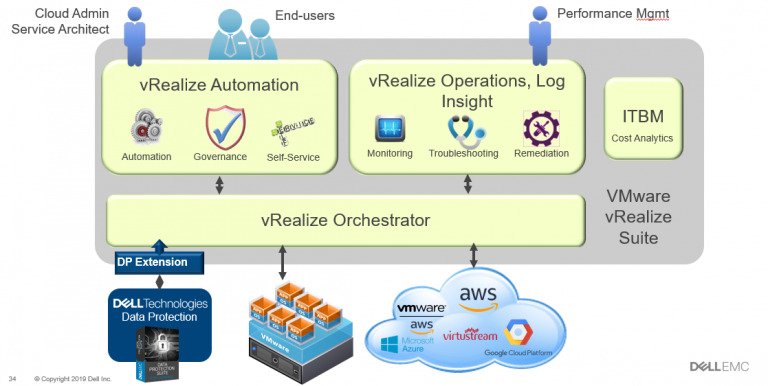
Dell EMC’s data protection automation provides companies with an easy and seamless way to ensure their data is always protected.  Specifically, infrastructure automation is attribute-based inclusion and exclusion, where IT admins can set rules to be used for VM discovery and inclusion, as well as flexible and powerful REGEX matching. It can be auto deployed by either SDDC deployer (auto deploy backup, target and join vSphere), auto deploy proxy data movers, and auto deploy in AWS or other marketplaces. Additionally, Dell EMC offers orchestration automation to move data directly from the VMs to the intended storage target, both on-premises and in the cloud. Dell EMC’s data protection solution is Networker-based, comprised of workflows that enhance the existing catalog with Networker data protection provisioning and job status checking tasks. Using vRealize Orchestrator, Dell EMC’s data protection solution are easily integrated into the VM environment, ensuring simplicity and ease-of-use in a familiar UI environment.

Dell EMC Study Materials, Dell EMC Guides, Dell EMC Learning, Dell EMC Certifications
The data protection approaches discussed in the webinar provide customers with the performance and simplicity that they need to address the operational and compliance requirements for their hybrid cloud environments. Organizations see hybrid cloud capabilities as a combination of data center, public cloud, and edge infrastructure. Customers benefit when their data center integrates and works seamlessly with their public cloud and edge infrastructure while utilizing their existing teams, skillsets, tools, and processes. With VMware, Dell EMC offers the full spectrum of data protection solutions for any cloud environment.

Wednesday, 14 August 2019

Dell EMC VxRail Just Derailed the Competition

Dell EMC VxRail, Dell EMC Study Materials, Dell EMC Tutorials and Materials, Dell EMC Learning

No matter when you hopped on the hyperconverged infrastructure (HCI) train, one thing is certain – it hasn’t slowed down. The rate and pace of growth in this space is picking up steam as organizations continue to look for ways to modernize their data center, cut infrastructure expenses and drive innovation.

Mind the gap


The gap between Dell EMC’s HCI systems portfolio and the rest of the industry is widening. IDC recently released its Q1 2019 Worldwide Converged Systems Tracker, and once again, Dell EMC is No. 1 in HCI system sales with 32% share. We’ve held this position for the last eight consecutive quarters. That’s right—two years! According to IDC’s research, we’ve experienced 64% revenue growth year over year, which is out pacing the rest of the industry. What’s more, is that VMware is doing the same as No. 1  in the HCI software category with 41% share.

The common denominator? Dell EMC VxRail. And VxRail is flying by our competitors like a runaway train. In this same IDC tracker, Dell EMC VxRail has taken over the No, 1 spot in hyperconverged systems!

We could not have gotten here without our thousands of customers, who trust us to help solve their business challenges. We hear from our customers every day how VxRail plays an instrumental role in making your business work better. Here are a few things you told us you like most about VxRail:

◈ Configurability – VxRail is the foundation for data center modernization plus a whole lot more. You can do just about anything with VxRail wherever you are in your IT journey.

◈ Integrated lifecycle management – VMware Cloud Foundation on VxRail makes operating the data center fundamentally simpler by bringing the ease and automation of the public cloud in-house by deploying a standardized and validated network flexible architecture with built in lifecycle automation for the entire cloud infrastructure stack including hardware.

◈ Serviceability – With VxRail, you get secure remote support, proactive monitoring and parts replacement and built-in knowledge articles.

◈ Support – You have a single point of support for both the hardware and software with a 95% CSAT score.

Dell EMC VxRail, Dell EMC Study Materials, Dell EMC Tutorials and Materials, Dell EMC Learning

On behalf of our entire VxRail family, thank you!

We are beyond excited about this latest news. Since the inception of VxRail just a few short years ago, we have prided ourselves in our ability to help our customers innovate their business faster and easier, across core data centers, at the edge and public clouds.

Our fuel is innovation – taking you to your destination of choice


While some others have started to decelerate, we’re still shoveling more coal on the fire. VxRail, with over a $1B annual run rate, is still the fastest growing HCI system among top 3 product brands. And we don’t plan on putting on the brakes anytime soon as we continue to advance our HCI systems portfolio with enhancements like machine learning based monitoring and analysis with VxRail Analytical Consulting Engine (ACE) that we announced at Dell Technologies World a couple of months ago.

Plus, we are further increasing our leadership position by continuing the innovation behind VxRail, jointly with VMware, to be better together. In core data centers, the majority of our VxRail customers run enterprise applications powered by vSAN. At the edge, we offer a wide range of solutions depending on what the edge means to you. This spans easily managed end-to-end VDI solutions using VxRail and VMware Horizon 7 to VMware Cloud on Dell EMC, which offers a data center-as-a-service at the edge or the core data center. And, for connecting with public clouds, VxRail is the ideal hybrid cloud infrastructure foundation for the Dell Technologies Cloud Platforms with VMware Cloud Foundation on VxRail. This is a game changer! VxRail is the only jointly engineered HCI system with VMware Cloud Foundation offering full stack integration and automated SDDC infrastructure deployment. You have a one stop shop with Dell Technologies.

Hop on board


If you have been thinking about hyperconverged but haven’t yet punched your ticket…there is no better time than now to grab a seat! The No. 1 Dell EMC VxRail is built on principles that deliver turnkey simplicity, automated end-to-end lifecycle management, and a highly differentiated experience for the fastest and simplest path to IT outcomes.

So, whether you’re looking to modernize your data center, deploy a hybrid cloud environment, innovate at the edge or looking to accelerate your application transformation, hop on board, get comfortable and enjoy your transformation ride with VxRail.

Saturday, 13 July 2019

You’re a Technology Company. Now What?

One of the greatest things about product releases and the excitement they draw, is the opportunity to sit down and talk with customers. Yes, customers want to talk to us about what’s new, but more importantly, they want to share incredible stories about their journeys. As you listen to these stories, it becomes crystal clear the “technology knife fights” vendors get into pale in comparison to the economics and business realities these businesses face. Let’s unpack what this means.

Dell EMC Study Materials, Dell EMC Guides, Dell EMC Online Exam

Digital Transformation – it’s not just a buzzword, it’s the new reality. Every organization in every industry is taking big strides to apply technology to their business. The truth is, it’s not even a choice anymore; it’s a key vehicle to gaining competitive advantage, and in many cases, a mode of survival. I remember a few years ago when Walmart, on a financial analyst call stated, “we are a technology company”. Yes, they know retail better than most anyone, but their future success was dependent on transitioning to this digital age. Data is now one of the most critical and valuable assets organizations can own, but only if it is leveraged to drive operations and delivers insights.

Digital transformation presents an interesting dilemma for businesses – they have substantial technology investment decisions to make, and concerns about their ability to consume and onboard that investment in technology in a manner that isn’t overly disruptive. Cloud becomes one of the most obvious solutions organizations look to – consume only what you need, scale up to meet growing demands, and put the power in the hands of employees – what an incredible promise. But there are organizational realities that must be accounted for, especially when injecting technology like cloud.

Skillsets and Process Mismatches


Most organizations have already made substantial technology investments and as a result, resources have been hired with the skillsets tied to those investments. New technology and sweeping changes require new investments in reskilling and can be bad for employee satisfaction, morale, and retention. Additionally, existing processes likely add tremendous value and are often the product of extensive research and applied learnings over the years. Will you miss these processes if they are removed? What should they be replaced with? If these questions are not answered for both your skillsets and processes, then the result is often the injection of a lot of risk into the organization, or costly remediation efforts.

Talent Scarcity


There is vast competition for technical talent. These resources are being bombarded with tantalizing offers to join the big brand tech organizations and up-and-coming startups. Your business could potentially face an uphill battle securing the best and brightest. It could necessitate the need to pay a premium for some tech roles. This can result in not having the right skillset in house to make use of all these new technologies.

Putting Innovation on Hold


The whole point of digitally transforming is to apply technology to the business and leverage data as a competitive advantage. The longer it takes to digest the infusion of technology into the business, and apply it to business activities means the longer it takes to see the fruits of your digital transformation. The larger the scale of the change, the longer it takes if your IT staff get bogged down in a protracted migration or re-platforming effort that can have a material impact on a quarter or fiscal year.

Elevating Your Cloud Strategy


It is essential for your organization to land on a pragmatic cloud strategy that applies a filter that looks at your people, process, and objectives while selecting the technologies to onboard and to what degree. It’s not so much what “operational nirvana” looks like. It’s a matter of what can feasibly be accomplished.

1. Take a look at your existing processes and see what can be leveraged and ported to the cloud to lower the friction of adoption and lower the complexity of the shift to a new operating environment.

2. Don’t get sucked into bleeding edge technologies and the promises they might hold if there isn’t a corresponding way to incorporate them into your business. Search for solutions that align with your organizations’ resources or for widely adopted technologies that offer a wide selection of resources.

3. Cloud offers a lot of great things, but you shouldn’t let cloud exuberance get in the way of an orderly transition to this new environment. Applications should be vetted, strategies should be clear, and early wins should be established before attempting massive overhauls.

It is important to keep your options open by deploying in hybrid environments that offer portability and reduce the management overhead of maintaining two or more clouds. Many CIOs we’ve talked to indicate that even when they make a substantial investment in the cloud, they have maintained facilities to mitigate the risk should a cloud exodus be required later.

By applying a methodology that accounts for business imperatives and sustainability in your technology selections and investments, you can avoid the pitfall of over pivoting in your desire to put a compelling technology in place. At the end of the day, technology needs to serve the business need, even if you’re now a technology company.

Saturday, 6 July 2019

Dell EMC vs AWS—USD Reveals True Economics

University of San Diego (USD) is one of the top Catholic universities in the nation, recognized for our academic excellence and development of leaders who become change-makers in a variety of fields.

We’re known for the exceptional personal classroom experience we offer students, with world-class professors teaching undergraduate class sizes that are limited to 30 students. But we also leverage technology to deepen and extend our rich academic and extracurricular offerings—such as delivering more than 1,100 online and hybrid courses and “flipping the classroom” to allow professors to share lectures electronically and use class time to engage students in discussions and answer questions.

Dell EMC Study Materials, Dell EMC Learning, Dell EMC Guides, Dell EMC Tutorials and Materials

Ensuring that our students and faculty have all the solutions needed to excel isn’t easy and we’ve invested in many different advanced technologies to accomplish this. We thought it would be relatively simple to bring these together and support our own virtual IT infrastructure. Unfortunately, trying to do it ourselves proved to be more costly and time-consuming than anticipated.

In 2011, we turned to Dell EMC Vblock® Systems to become the core of our compute and storage, running hundreds of educational and business applications. And now, four years later, we’re continuing to modernize our IT infrastructure with a new VxBlock™ System 350 to support our four campus data centers. Plus, we rely on a hyper-converged Dell EMC VxRail™ Appliance at our disaster avoidance site in Phoenix, Arizona.

To determine our infrastructure refresh strategy, we performed extensive analyses to compare the cost and efficiency of using Amazon Web Services (AWS) versus our Dell EMC-supported private cloud infrastructure. And what we discovered made choosing to update our Dell EMC footprint a no-brainer.

Dell EMC was significantly less expensive than AWS. Here are some of the details:

Lower cost

◈ We spent about $900,000 on our first Vblock System over four years

◈ Dividing by 48 months, that works out to approximately $19,000/month, or $30/hour

◈ This is the equivalent of about 100 AWS EC2 instances with up to 100GB of attached storage, and that doesn’t include the cost of monthly support from AWS.

Higher capacity

◈ Based on these figures, we calculated that we could run 4x the number of solutions in our VxBlock System-supported private cloud for the same cost as the AWS public cloud

Faster access

◈ Plus, by utilizing an on-site Dell EMC solution, we can connect the VxBlock System to our other three campus data centers at 10 Gbps and provide on-campus access to users at a head-turning 1 Gbps—compared to AWS’s Internet-speed connections

It’s true that I could purchase AWS EC2 Reserved Instances for one or more years and reduce my public cloud costs a bit, but AWS still wouldn’t be cheaper than Dell EMC!

At USD, users rely on the IT infrastructure to be continuously available so they can use the latest technologies without thinking about it. Our goal is to achieve a mindset of, “We’re in the higher education business—we just happen to use IT to deliver services.”

Dell EMC Study Materials, Dell EMC Learning, Dell EMC Guides, Dell EMC Tutorials and Materials

Since we implemented our first Vblock System, our IT Services team has been able to focus on innovation and adding value, rather than on simply keeping the lights on. A key component of this has been the converged and hyper-converged support, which enables us to get assistance anytime we need it with a single phone call—without the finger-pointing one experiences when dealing with multiple vendors.

I was just talking with some colleagues about our plans to roll out our new VxBlock System, and it’s nice to be able to say I’m investing in my second Dell EMC solution because I’ve determined it’s one-quarter of the cost of AWS.

Sunday, 16 June 2019

Dell EMC Doubles Down on VxBlock at Cisco Live: Introducing NVMe Innovations, VxBlock Central 2.0

Earlier this Spring, Dell EMC reaffirmed its decade-long commitment to converged infrastructure (CI) through the multi-year extension of its longstanding systems integrator agreement with Cisco.

At the heart of our CI strategy is the VxBlock 1000, a system that delivers a true mission critical-foundation for the hybrid cloud and helps customers achieve greater simplicity and efficiency.

Dell EMC Study Materials, Dell EMC Certifications, Dell EMC Guides, Dell EMC Learning

This year at Cisco Live, Dell EMC is excited to make several announcements that deepen VxBlock 1000 integration across servers, networking, storage and data protection. Together, these announcements represent the next key milestone in our commitment to CI innovation and our customers —backed by our strong relationship with Cisco.

Here’s a look at what we’re announcing today:

Realizing the Power and Performance of NVMe Over Fabrics


NVMe is key to unlocking the next level of cloud operations on CI, but the full business benefit of NVMe can only be realized with an end-to-end infrastructure enabled by NVMe over Fabrics (NVMe-oF).

To help customers realize the full power of NVMe-oF, Dell EMC is announcing new integrated Cisco compute (UCS) and storage (MDS) 32G options, extending PowerMax capabilities to deliver game-changing NVMe performance across the VxBlock stack. This further enhances the powerful architecture, consistent high performance, availability and scalability that’s become synonymous with the VxBlock, helping you to meet the most demanding requirements of high-value, mission-critical workloads.

Now, customers can benefit from extreme end-to-end system performance with one system that can evolve from today’s millisecond to tomorrow’s microsecond latency.

These new compute and storage options will be available to order later this month.

Extending Integrated Data Protection to the Cloud


Dell EMC developed the concept of integrated data protection to help customers protect different tiers of applications and data efficiently and cost effectively — and with precisely the right level of protection for each business need.

While legacy data protection “bolted-on” to a new converged system might work, it may not provide the right level of protection for each service-level need. That’s why Dell EMC offers a flexible family of options for streamlined backup and recovery, data replication, business continuity, and workload mobility to deliver reliable, predictable, and cost-effective availability for Dell EMC converged infrastructure.

As of today, we’re extending our trusted, factory-integrated on-premise integrated protection solutions for VxBlock to hybrid and multi-cloud environments, including AWS. This release, which will be available to order in July, features options to help protect VMware workloads and data using new cost-effective Data Domain Virtual Edition and Cloud Disaster Recovery software options.

Simplifying Cloud Operations with VxBlock Central 2.0


Since its introduction in November 2018, Dell EMC VxBlock Central software has helped customers simplify CI administration through converged awareness, automation and analytics.

Today, we’re proud to announce VxBlock Central 2.0. Available this July, VxBlock Central 2.0. features new modular licensing that matches workflow automation, advanced analytics and life-cycle management/upgrade options to your needs.

VxBlock Central 2.0. licensing options include:
  • Base – Free with purchase of a VxBlock, the base license allows you to manage your system and improve compliance with inventory reporting and alerting.
  • Workflow Automation – Provision infrastructure on-demand using engineered workflows through vRealize Orchestrator. New workflows available with this package include Cisco UCS server expansion with Unity and XtremIO storage arrays.
  • Advanced Analytics – View capacity and KPIs to discover deeper actionable insights through vRealize Operations.
  • Lifecycle Management (new, available later in 2019) – Apply “guided path” software upgrades to optimize system performance.
    • Lifecycle Management includes a new multi-tenant, cloud-based database based on Cloud IQ that will collect and store the CI component inventory structured by the customer, extending the value and ease of use of the cloud-based analytics monitoring.
    • This feature extends the value and ease of use of the cloud-based analytics monitoring Cloud IQ already provides for individual Dell EMC storage arrays.

A Decade of Innovation Continues


Dell Technologies is #1 in IDC’s Certified Reference Systems & Integrated Infrastructure Tracker with a 47.8% share —1.5X that of the next vendor.* If you’re attending Cisco Live US in San Diego, June 9-13, stop by to talk with Dell EMC to see that innovation first-hand.

Monday, 27 May 2019

New Paths to Microsoft Hybrid Cloud with Dell EMC

Today, Microsoft is hosting its annual Windows Server Summit – a virtual event that we encourage you to join wherever you may be!  One of the major themes is “Innovations in Microsoft Hybrid Strategy: a deep dive into Microsoft’s hyper-converged technologies and how to add hybrid services from Azure.”

Dell EMC Study Materials, Dell EMC Guides, Dell EMC Certifications

As one of Microsoft’s biggest partners, Dell EMC has collaborated with Microsoft to develop hybrid solutions for years. Our Azure-dedicated portfolio today includes support for both Azure Stack and Azure Stack HCI.  Azure Stack, an extension of Azure on-premises that can run on Dell EMC hyperconverged engineered systems, allows users to consistently build and run cloud applications anywhere across the Azure ecosystem, using the Azure Portal with Azure IaaS and PaaS services. With Azure Stack HCI, a BYO on-prem private cloud solution, users can run virtualized workloads in a familiar and flexible way – but with the efficiency of Dell EMC hyperconverged infrastructure – and connect to Azure public for hybrid scenarios such as cloud backup and cloud-based monitoring.

These two different offerings provide our joint customers with the ability to choose how they achieve a hybrid cloud environment in Azure that addresses their unique goals. Today we’re pleased to announce that Dell EMC has expanded our Azure Stack HCI portfolio with Storage Spaces Direct Ready Nodes supporting Windows Server 2019.

This new offering leverages the Windows Server Datacenter license to provide software defined storage, using Hyper-V virtualization down to the storage level.  These multi-node clusters provide cost effective volumes with high performance and low latency, using common management tools.  In addition to our previous 15 use case-driven configurations under WSSD, Dell EMC has added:

◈ Windows Server 2019 to all 15 configurations, offering more choice and expandability

◈ Our newly released storage dense PowerEdge R740xd2 as a new chassis platform, allowing for more demanding workloads

◈ QuickStart – a 4 node, 2 switch configuration that’s an easy to order and deploy, end-to-end high availability solution

◈ Dell EMC PowerSwitch 25GbE networking to increase throughput

◈ A new upgrade service, taking customers from existing Storage Spaces Direct Ready Node architectures to Windows Server 2019 with continued support entitlement

◈ Integrated and unified systems management with the OpenManage Integration 7.1.1 for Microsoft System Center Virtual Machine Manager that simplifies cluster creation and maintenance tasks

2019 has also been a big year for Dell EMC Cloud for Microsoft Azure Stack as we’ve released several additions to our platform:

◈ In March, we announced Dell EMC’s Tactical Azure Stack to bring Azure-based services from the cloud to the edge. This ruggedized version of Azure Stack provides an Azure-consistent cloud in a harsh, mobile, or forward-deployed environment.

◈ Today, we’re announcing Azure Stack is now available on our PowerEdge R840 platform. As an all-flash system, it is a four-socket server validated and tested for Microsoft’s hybrid cloud solution.  Designed and configured to support high performance and data-intensive workloads in Azure Stack environments, the R840 enables customers to leverage the maximum levels of computing resources and SSD capacity available in a 2U footprint.

◈ We’re also excited to announce we now offer a metered usage consumption model for Azure Stack infrastructure, with Flex on Demand from Dell Financial Services. This measured service capability aligns with the OPEX type consumption model that customers desire.

Dell EMC has a long history of co-engineering with Microsoft and these new enhancements further strengthen our joint portfolio across hyperconverged infrastructure and hybrid cloud solutions. By working together to deliver innovative services faster and more frequently, we can become a real partner of change for our customers in this Digital Transformation era.

Monday, 13 May 2019

Evolution of HCI: Greater Flexibility Than Ever Before

No matter the product, a large purchase is an important decision—all the more so if it is for your business. But often times the choice we make—even after careful consideration and plenty of research—can leave us with a feeling of buyer’s remorse. In IT this could happen for any number of reasons—as change and churn occur, business needs evolve and requirements from development teams shift, and you may find yourself in an environment that you did not anticipate. What you really need then is a multi-talented, agile architecture designed with the future in mind. Luckily, this type of flexibility is exactly where VxFlex (formerly known as the Flex family) shines.

Dell EMC Study Materials, Dell EMC Certifications, Dell EMC Guides

The VxFlex family is an offering within the Dell EMC HCI portfolio whose strength is its… you guessed it: FLEXibility! VxFlex can adapt to heterogeneous environments, support multi-hypervisor environments and bare metal options, and even give customers the ability to scale storage and compute independently or together. We can offer this while enabling a modular expansion that truly adds incremental IOPS and compute performance without introducing increased latency in an all flash solution.

The VxFlex family offers several deployment options depending on your needs. VxFlex Ready Nodes provide great flexibility through pre-validated and optimized HCI building blocks, whereas the integrated rack (formerly known as VxRack FLEX) is a fully engineered system with networking included that accelerates IT outcomes through full lifecycle management. Both are powered by VxFlex OS, the enabling software defined technology for the VxFlex family (with over an exabyte sold).

Since HCI is all about agility and simplicity, it was a logical next step for us to expand Dell EMC’s VxFlex portfolio with a new offering to complement the existing Ready Nodes and integrated rack. And that’s what we just announced at Dell Technologies World. I am excited to introduce the newest member of the family: VxFlex appliance!

VxFlex appliance offers a crucial middle ground by delivering many of the HCI benefits of a turnkey, integrated system (such as integrated lifecycle management, easy scale out capabilities, faster deployment and single source for support) but in a simplified and more economic form factor.

This new offering makes the VxFlex family even more versatile by taking the best of what’s offered in the Ready Node and integrated rack and blending it together with the power of VxFlex OS software to deliver the following flexibility and cost saving features:

◈Bring your own networking (like Ready Node)
◈Smaller starting point with massive growth potential (like Ready Node)
◈Controller running on a VM saving you a management controller node (like Ready Node)
◈Unified management with VxFlex Manager (like integrated rack)
◈VxFlex OS for software defined (like the entire family)

Customers of all sizes and verticals are loving their transformation with VxFlex. From the biggest enterprises with over 3,500 nodes in their environment capable of millions of IOPs with consistent low latency to smaller companies just starting out with eight nodes (but with the ability to scale out as their needs grow)—VxFlex enables them to innovate and boldly go where no one has gone before and focus on what they do best to make the world a better place. These high-performance capabilities set VxFlex apart from other leading HCI appliances that support multi-hypervisor or bare metal environments. This enables us to offer you VxFlex as the premier HCI appliance option for these environment types with enterprise-grade resiliency and high performance for the fastest access to data and applications.

Regardless of the VxFlex family option you decide to adopt, you’ll benefit from one number to call for the full solution. Also, with all the underlying hardware, networking and VxFlex OS software under one roof, we can get innovation and new updates to you as fast as we can churn them out.

So, when it comes time for your next IT infrastructure decision, consider the newest addition to the VxFlex family. VxFlex appliance demonstrates Dell EMC’s continued investment and commitment to growing and innovating the VxFlex family, it’s a decision you won’t regret.

Friday, 3 May 2019

VxRail is Holding an ACE

I’m here in Las Vegas for Dell Technologies World and I think it’s an absolutely fitting location to let everyone know that VxRail is getting ready to flip over its ACE. However, unlike the mythical ace of spades, VxRail Analytical Consulting Engine, or ACE, gives you the winning hand in your VxRail environment every time. And VxRail ACE, with its cloud connectivity to the VxRail HCI System Software, is a great tie to the Dell Tech Cloud story we announced yesterday.

Dell EMC Study Materials, Dell EMC Certifications, Dell EMC Guides

As IT becomes more complex, it’s time to shift the odds from the house to your favor. Dell EMC ACE actively monitors and provides management guidance for the entire hyperconverged stack. Leveraging artificial intelligence and infrastructure machine learning, VxRail ACE will drive increased operational efficiencies through automation.

As a virtual infrastructure administrator, you’re still playing your hand but you can count on VxRail ACE to be aware of the way things should be done, such as ensuring healthy capacity utilization rates and forecasting resource consumption to keep your HCI stack operating at peak performance; ready for future workloads.

Improving Your Odds


Unlike in Las Vegas, VxRail ACE gives you best practices so you always have more than luck on your side when managing your IT environment. VxRail ACE uses a data lake, with historical data of how customers are using VxRail, and machine learning to identify ways to optimize configurations and streamline infrastructure management. VxRail ACE can help you tackle day-to-day management while keeping an eye out on the horizon so you can make informed decisions – and the more hands that get played, the smarter VxRail ACE gets.

Winning at cards is all about knowing the odds. In Las Vegas, the house always has the advantage. That’s not the case with VxRail ACE in your hand. VxRail ACE can show you the odds of going over capacity. The odds of needing additional performance. The odds that upgrading VxRail to the latest version will enhance your IT environment and business and even detect anomalies in your environment and learn from them.

Doubling Down on ACE


VxRail ACE can help predict future storage capacity requirements

VxRail ACE is an extension of the VxRail HCI System Software that leverages an Adaptive Data Collector (ADC) and using Dell EMC Secure Remote Support (SRS), collects telemetry including events, alarms, utilization and more from the VxRail clusters for processing and analytics in our secure cloud-based data lake. Here our analytics compute engines analyze the data to produce valuable information that you can view for your entire VxRail estate and act on, along with an associated health score for each and every cluster and associated telemetry.

Moreover, as we move forward, we will be doubling down on the functionality delivered in ACE. Our vision for VxRail ACE is to offer action in addition to insights, as future functionality will allow it to troubleshoot issues saving IT valuable time.

Read More: DES-4121: PowerEdge Specialist Exam for Implementation Engineer

And like a professional player coaching you, VxRail ACE is currently in use by Dell EMC Services to ensure system and version accuracy across the install base, including monitoring vitals such as installed OS and physical configurations to start so that you always have another set of eyes helping you play your best hand. Being able to detect anomalies and trend data to create projections reduces manual oversight while increasing service uptime.

ACE Part of a Full House of VxRail Software


VxRail ACE is a key component of VxRail HCI System Software

Since you can’t win the pot with a single card, VxRail gives you a full house with VxRail HCI System Software. Further, the Dell EMC VxRail turnkey experience offers full stack integration – control from top to bottom, of software and hardware together – for a consistent, deeply integrated VMware environment. VxRail goes even further to deliver even more highly differentiated features and benefits based on the VxRail HCI System Software, the orchestration engine for unique automation, integration, management, analytics, and extensions for VxRail environments, which is unique to VxRail and automates deployment, delivers complete lifecycle management, and facilitates key upstream and downstream integration points that create a truly better together experience with VxRail as the foundation.

Best of all, We’re Sharing our ACE with you


VxRail ACE will be available for early access at the end of May. We’re making it available to you to try out at no charge. That’s right, there’s no ante to get access to our ACE. This means there’s no additional software or hardware to install. Everything is delivered via a user-friendly, fully customized portal available through your Service 360 accounts. Why are we doing it this way? We know we have invaluable expertise in our customers. We want to collaborate with you to ensure you’re vested in the development of VxRail ACE so it gives you the value you need. We’ll be working on a continuous innovation/continuous development (CIDC) cadence so you’ll always have the latest and greatest features at your fingertips

Wednesday, 24 April 2019

Ready Stack: Flexibly Build Your Own Converged Infrastructure

Sometimes, the turnkey approach is the best and fastest approach to modernization. But sometimes, customers need a custom solution that they can build for themselves, or with the support of trusted partners.

Dell EMC Study Material, Dell EMC Tutorials and Materials, Dell EMC Certifications

That’s why we’ve created Ready Stack – a portfolio of validated designs that enable customers to build their own converged infrastructure data center solutions. It’s great news for them – and great news for you, because you can work with them to design and deploy converged infrastructure on a fast and simple sales cycle.

Your Solution, all from Dell EMC

Ready Stack combines component technologies from a single source –Dell EMC, the leader of the overall Converged Systems segment, with more than 2X the revenue share of its nearest competitors1. All-flash storage, next-generation servers, data protection portfolios, and leading open networking solutions come together to help you reduce complexity and risk, and save time and hassle.

Ready Stack’s validated designs include:

◈ VMware IaaS on PowerEdge MX Servers and PowerMax Storage

◈ Microsoft Hyper-V on PowerEdge 14G Servers and Unity Storage

◈ VMware vSphere on PowerEdge 14G Servers and Unity Storage

By sourcing everything from one vendor, customers can greatly reduce the complexity of purchasing, provisioning, and deployment – which means that with Ready Stack, you’ll be offering a highly attractive proposition with fast time to value.

Partner benefits


Dell EMC Study Material, Dell EMC Tutorials and Materials, Dell EMC Certifications
Ready Stack industry-leading data center component solutions are designed to make it easier for you to:

◈ Increase sales, increase prospects and deepen customer relationships

◈ Achieve faster time-to-revenue

◈ Target flexible options more accurately to cases

◈ Reduce risk

◈ Improve opportunities to upsell services, which can help increase margins on your deals – including deployment services (with the appropriate accreditation)

◈ Showcase your range of competencies, from servers to storage, from core to cloud, and from workstations to IT transformation

◈ Benefit from incentive and rebate opportunities as part of our Partner Program

Tuesday, 23 April 2019

Dell Technologies and Cisco Reaffirm Joint Commitment to Converged Infrastructure with Multi-Year Agreement

There’s industry chatter about what the growing adoption of hyperconverged infrastructure (HCI) might mean for the converged infrastructure (CI) space. As a company that retains its top spot in IDC’s Certified Reference Systems & Integrated Infrastructure Tracker with a 48% share — nearly 1.5X that of any other vendor — and serves thousands of customers who rely on CI, Dell EMC thinks it’s clear CI will remain a popular choice for years to come.

Dell EMC Study Materials, Dell EMC Certifications, Dell EMC Learning, Dell EMC Tutorial and Material

We continue to invest in energizing the CI space, helping customers to modernize and automate for the cloud era on our VxBlock 1000 platform. With this legacy of leadership and innovation, it’s no wonder IDC reports that Dell EMC is the #1 provider of converged systems for the past six years.

Today, we’re announcing the next key milestone in our commitment to CI innovation: the multi-year extension of our longstanding systems integrator agreement with Cisco.

“It’s difficult to overstate Dell EMC’s decade-long commitment to the converged infrastructure market,” said Eric Sheppard, Research Vice President, IDC. “The enormous resources Dell EMC has invested into this market have been directly responsible for driving down data center costs, complexity and risk for the many organizations running the company’s converged infrastructure all around the world. Dell EMC’s continued investments also stand as proof of the company’s commitment to the market and a deep belief in the benefits convergence brings to the datacenter.”

Working Together to Drive CI Innovation and Value

As you may know, Dell EMC (then EMC) and Cisco were the first to market with a CI system when we formed a joint venture with VMware in 2009.

Since then, Cisco has provided networking (Nexus) and compute (UCS) technology for Dell EMC through multiple iterations of VxBlock, while Dell EMC has continued to be a top-tier reseller of Cisco technology. Cisco rounds out the all-in-one VxBlock 1000 technology stack that’s built on powerful Dell EMC storage and data protection, giving businesses a reliable and highly performant platform for VMware cloud operations.

The newly inked agreement entails continued company alignment across multiple organizations: executive, product development, marketing and sales. This means we’ll continue to share product roadmaps and collaborate on strategic development activities, with Cisco investing in a range of Dell EMC sales, marketing and training initiatives to support VxBlock 1000.

Most recently, this joint development introduced Cisco UCS 6454 fabric interconnect support for higher scale, performance and throughput in VxBlock 1000, as well as a broader range of Cisco M5 server options, including the new Performance Optimized UCS C480 M5.

With so many cloud-ready capabilities in VxBlock 1000, we are seamlessly bridging our CI customers to the new multi-cloud landscape.

Customer Benefits from this Powerhouse CI Partnership

The primary factor driving Dell EMC and Cisco’s commitment to working together on CI is the enormous range of benefits it provides each of our customers.

VxBlock 1000 users experience improved assurance and lower operational risk through Dell EMC’s lifecycle management of the included Cisco technologies, which are fully integrated into a single infrastructure stack along with Dell EMC storage and data protection. They also enjoy faster support and time to resolution thanks to Dell EMC’s specialized support staff, who are highly trained and experienced in working with Cisco technologies.

The joint commitment also delivers ongoing, rapid access to fully tested Cisco technology options that are incorporated into VxBlock 1000. Of course, none of these benefits would be worthwhile if our joint projects didn’t also deliver on the promise of CI — with consistently simpler, faster ways to support mission-critical workloads and cloud initiatives.

I know I speak on behalf of Dell Technologies in expressing excitement and appreciation for our continued alliance with Cisco around this highly successful CI business. Our collective investments of engineering, technology and support has resulted in a decade-long leadership position of the CI category bolstered by a long list of innovations built into the VxBlock 1000 platform. It’s a sentiment that we don’t take lightly and is something we’re grateful is also shared by our partners at Cisco.

“Cisco is committed to the partnership with Dell EMC and to jointly delivering innovative solutions for our VxBlock customers. By extending this agreement, we are continuing to provide powerful and integrated technologies with Cisco UCS, Nexus and MDS and delivering on our commitment to innovation for VxBlock.” – Frank Palumbo, SVP, Global Data Center Sales, Cisco

Watch for More VxBlock 1000 News

We’re eager to continue building on our 10-year history of CI system innovation with Cisco and look forward to sharing more milestones with you. Watch for additional joint innovation announcements regarding VxBlock 1000 later this year.

Thursday, 11 April 2019

It’s Time for the Media and Entertainment Industry to Virtualize

When it comes to virtualization, the media and entertainment (M&E) industry has lagged other industries. For 30 years, broadcast engineers have relied on bare-metal hardware and hard-coded applications, trusting that these solutions could deliver the performance and predictability required of a broadcast network.

Dell EMC Study Materials, Dell EMC Learning, Dell EMC Tutorial and Material

Broadcast engineers have been wary of virtualization. But for M&E, virtualization in private, public or hybrid-cloud environments offers many tangible benefits: streamlined workflows, increased automation, lower cost of ownership, reduced production time and much more. In fact, forward-thinking media companies are now realizing that virtualization is the only way they’ll be able to compete in a new and rapidly evolving digital marketplace.

However, these benefits can only be realized if all components works seamlessly together. To ensure this, Dell Technologies is partnering with many of the world’s leading independent software vendors (ISVs) to test, qualify and prove the functionality of underlying VMware vSphere-based solutions and virtualized configurations.

Advantages of Media Function Virtualization (MFV)


Prior to VMware, broadcast engineers relied on single-operation hardware, which was limited to one job at a time, whether it was playout, transcoding or rendering. With MFV, media companies can execute multiple tasks on a single Dell EMC VxRail hyperconverged node – an integrated system co-engineered by Dell EMC and VMware.

For instance, we have a qualified solution with an ISV that enables us to get 2 – 4 compute tasks, doing either the transcode or the renders on a single VxRail, versus running each job on a separate server. So, what used to take 20 or 30 physical servers is now handled on seven or eight 1U VxRail systems.

VMware vSphere can also create robust automated environments. This enables virtual machines (VMs) to move between clusters and stretch clusters to provide higher availability and reliability. If an environment goes down or is taken offline, the application can seamlessly shift to another storage array or vSphere host without any interruption or impact to the user.

Now, VMware vSphere advances also allow you to run OTT client applications in VMs, as well as host the core video streaming applications for many broadcast and media solutions.

Virtualization’s expanding role


As the industry progresses toward “IP Playout” delivery, the role for virtualization continues to increase. Broadcasters must compete for audience and advertising dollars by quickly offering new services and channels with specialized content.

Easy-to-deploy integrated playout solutions accelerate channel deployment well beyond the capability of traditional installations by offering a flexible, software-based architecture. This enables broadcasters to only pay for what they need and easily add new features as their business evolves.

Add to that the evolution of Dell EMC Isilon scale-out storage solutions, designed for high-performance and advanced production environments, enabling media companies to shape and configure resources to meet the demanding needs of each operation in the workflow.

Time is money


Traditionally, it would take 9-12 months for a customer to get their broadcast workload environment into production. They had to size the equipment, set it up, configure and test it extensively before going on-air.

With Dell Technologies, the configuration is already qualified and tested when the VxRail nodes arrive. VxRail can be up and running in a couple of days once the networking is ready. Once VMware vSphere is configured, the ISVs – who are familiar with the vSphere configurations and images – can load the base VMs that very day.

ISVs have tested and qualified this technology right in their labs, so they’re able to move your operation immediately into workflow customization. This is how environments that used to take 12 months to get running become operational – and collecting revenue – within three months. We’re talking about greatly accelerating revenue from ad sales and everything else that goes along with spinning up a new channel. It also can shorten their technology investment depreciation cycle.

This kind of efficiency has caught the attention of ISVs, some of which are now adopting VMware’s solutions as their underlying technology, with huge OEM potential.

Broadcast challenges


Uncompressed video streams with an IP playout – usually associated with live sports broadcasts – can present a significant challenge for broadcasters, who can’t have dropped frames, jitter or black space, so the requirements are extremely high.

The  ST-2110 standard requires 1.3 Gb/s bandwidth for an uncompressed UHD channel. To get multiple channels playing, we found it imperative to have the ISV engineering department working with our VMware vSphere Alliances & Performance Engineering team. It took a long time to solve these challenges, but we can now get two of these channels running on a single VxRail node.

One of our ISV partners spent nine months working on a hardware solution to solve this problem. They had no success, because it wasn’t a hardware issue – it was a virtualization-engineering feat. They needed a virtualization solution and Dell Technologies’ expertise. When we brought our VMware vSphere performance engineers to the table, our partners were finally able to overcome this issue.

Furthermore, when the next generation VxRail arrives with even more powerful CPUs, we expect to get up to four uncompressed live streams playing without any issue.

Lower total costs


VMware-powered solutions can help media organizations realize significant cost savings. A single VxRail – powered by VMware vSphere and vSAN – can do the work of multiple bare-metal servers. This results in less rack space, less power and a reduction in cooling requirements versus deploying server after server.

Finally, we’re in the early virtualization stages with M&E, but not in other industries where we have employed this solution successfully for years. It took the banking industry, for example, a year or so to understand how well virtualization works. Once they understood the tools and their comfort level increased, the technicians’ work became more meaningful and interesting, and the possibilities of virtualization began to be realized.

That’s where we’re heading with M&E, which is why it’s going to be such an exciting next phase in this industry.