Showing posts with label High Performance Computing. Show all posts

Sunday, 9 May 2021

Helping COVID-19 Long-Haulers with the Power of AI

Dell EMC Study Material, Dell EMC Certification, Dell EMC Preparation, Dell EMC Career, Dell EMC

Over the last year, the world fast-tracked digital transformation to understand the COVID-19 virus and create vaccines to protect human health. At Dell Technologies, we focused our efforts on providing funding, technology and expertise to help scientists and research institutions make a significant impact in the fight against the global pandemic.

We’re turning our focus to the next public health crisis: understanding and developing treatments for long-haul COVID-19. Patients with Post-Acute Sequelae of SARS-CoV-2 (PASC), or “long-haulers,” can experience illness for weeks or months after first being infected with the virus. An estimated 1 in 20 people with COVID-19 are likely to suffer from long-term symptoms including profound fatigue, brain fog, headaches, cardiac arrhythmia, fevers and shortness of breath.

While the idea of finding solutions for long-haul COVID-19 may be daunting, so was COVID-19 itself. And we now know that we can solve this and many other challenges with the incredible power of research accelerated by technology.

Dell EMC Study Material, Dell EMC Certification, Dell EMC Preparation, Dell EMC Career, Dell EMC
One of the organizations we work with, the i2b2 tranSMART Foundation, is bringing the global research community together in the fight against COVID-19, and we are proud to continue to support them as they embark on ground-breaking work to understand and drive precision treatments for those experiencing long-haul COVID-19. Using Dell Technologies’ modern infrastructure and expertise, the organization is creating digital twins – virtual models of COVID-19 patients – on which researchers will perform millions of individualized treatment simulations to identify the best possible therapy option for specific patients, based on genetic background and medical history.

As you can imagine, research at this scale requires mobilizing a massive amount of de-identified patient data, which means significant computational, storage, AI and machine-learning capabilities are needed to allow scientists to uncover actionable insights.

We were up for the challenge, and worked with i2b2 tranSMART to create a “data enclave” comprised of Dell EMC PowerEdge, PowerStore and PowerScale storage systems, as well as VMware Workspace ONE and Boomi integration services. This data enclave will give researchers the ability to gather, store and analyze data scattered across various monitoring systems and electronic health records and conduct treatment simulations  – with the insights shared with the broader clinical research community to accelerate the development of individualized treatments.

Supporting the global community is core to our purpose, and this collaboration with i2b2 tranSMART brings us one step closer to our goal of using our technology and scale to advance health, education, and economic opportunity for 1 billion people by 2030. The power of technology is astonishing, we see it in action every day. And when we use the same powerful, innovative technology to scale positive societal impact, there’s no limit to what we can accomplish together.

Source: delltechnologies.com

Saturday, 17 April 2021

Unlocking the Power of AI

Dell EMC Study Materials, Dell EMC Career, Dell EMC Preparation, Dell EMC Tutorial and Material, Dell EMC Learning

At VMworld 2020, NVIDIA and VMware shared their vision to work together to democratize and unleash AI for every enterprise. And that’s the case today as the companies roll out a jointly engineered solution that optimizes the latest update to VMware vSphere 7 — for AI applications with the NVIDIA AI Enterprise software suite on Dell Technologies.

The combination of technologies from these world-class companies makes it easier to access a rich menu of accelerated parallel-computing applications, AI frameworks, models and software development kits (SDKs). It gives AI researchers, data scientists and developers the software they need to deliver successful AI projects, while arming IT professionals with the ability to support AI using the tools they’re most familiar with for managing data centers and hybrid cloud environments.

Democratizing AI with VMware

VMware vSphere 7 Update 2 delivers powerful support for the latest NVIDIA A100 and new A30 GPUs, including enhancements to performance-boosting GPUDirect communications and new multi-instance GPU (MIG) partitioning. vSphere also delivers enterprise virtualization for GPU-powered AI workloads. And, vSphere is the only virtualization platform that enables vMotion for NVIDIA vGPU powered VMs, simplifying infrastructure maintenance while powering VMware Distributed Resource Scheduler for automatic initial workload placement for AI infrastructure at scale.

Boosting efficiency with NVIDIA AI Enterprise

NVIDIA AI Enterprise encompasses a suite of enterprise-grade AI applications and models that are designed to optimize business processes and boost efficiency for AI use cases across industries — from manufacturing and logistics to financial services, retail, healthcare and more. It gives users easy access to NVIDIA tools that power AI development across projects as diverse as smart factories, healthcare diagnostics and fraud detection.

And forget about AI silos. With NVIDIA AI Enterprise running on vSphere, organizations can avoid silos of AI-specific systems that create management headaches and security risks. With this combination of technologies, organizations can overcome the challenges that stem from deploying individual AI applications, as well as the potential failures that can result from having to manually provision and manage different applications and infrastructure software.

It’s Suite and Certified

Using the NVIDIA AI Enterprise suite and NVIDIA’s most advanced GPUs and data processing units (DPUs) in accelerated servers, enterprises using  vSphere for server virtualization can now more easily run accelerated AI workloads alongside existing enterprise applications on Dell Technologies-NVIDIA Certified Systems, with near-bare-metal performance.

Harnessing the power of AI with Dell Technologies

At Dell Technologies, we’re excited to see the rollout of NVIDIA AI Enterprise for vSphere on Dell EMC PowerEdge servers with NVIDIA A100 Tensor Core GPUs. That’s a point that is apparent in a comment from Caitlin Gordon, vice president, product management, Dell Technologies Infrastructure Solutions, in a VMware launch news release.

“Dell Technologies is focused on helping customers harness the power of AI by providing solutions that make it easier to adopt and use,” she notes. “Today’s news certifying NVIDIA AI Enterprise with VMware vSphere supports our efforts with both companies to provide NVIDIA A100-powered Dell systems that enable customers to benefit from AI anywhere, with continuous insights at scale, to help reach their business goals.”

Dell EMC Study Materials, Dell EMC Career, Dell EMC Preparation, Dell EMC Tutorial and Material, Dell EMC Learning

It was this same spirit that led to Dell Technologies becoming the first IT company to embrace innovation that helps businesses run powerful AI workloads in VMware environments, via easy-to-deploy Dell EMC Ready Solutions. As noted in a Dell Technologies news release, new Dell EMC Ready Solutions based on VMware Cloud Foundation help companies gain AI insights with the combination of Dell EMC systems and features of VMware vSphere to enable GPU virtualization.

Key takeaways

As organizations work to capitalize on the massive amounts of data they collect every day, AI is emerging as one of the most important enterprise applications — if not the most important application. It’s an essential ingredient to digital transformation and the move to the data-driven enterprise.

To enable this shift, organizations are using VMware to maintain consistent operations and governance for their multi-cloud environments, while providing automation capabilities to modernize their applications. For AI, teams previously had to use a different set of tools, however, now, AI applications can be easily managed with the same VMware flexibility as their other applications. The result: It’s easier than ever to develop, deploy and manage diverse AI workloads anywhere.

Source: delltechnologies.com

Thursday, 15 April 2021

Making Smarter, Faster Trades with AI and HPC

Dell EMC Study Material, Dell EMC Guides, Dell EMC Preparation, Dell EMC Career

In the new digital economy, data and the IT solutions used to harness it are often a financial services company’s primary source of competitive advantage. This is especially true for algorithmic trading, a highly automated investment process where humans train powerful software applications to select investments and implement trades automatically.

Also Read: DEA-2TT3: Cloud Infrastructure and Services Version 3 Exam (DECA-CIS)

The ultimate evolution of algorithmic trading is high‑frequency trading, where the algorithms make split‑second trading decisions designed to maximize financial returns. Automating trading and removing humans from the hands-on process has several advantages, including reduced costs, greater speed and improved accuracy.

High‑frequency trading platforms deliver competitive advantage through their ability to place thousands of trades before the market can react. Given this new reality for the industry, high‑frequency trading has led to competition in computational speed, automated decision making, and even connectivity to the execution venue to shave off microseconds and beat other traders to opportunities.

In light of these compelling business benefits, it’s no surprise that algorithmic trading is becoming more the norm than the exception for financial trading firms.

Developing the algorithms

To develop trading algorithms, financial firms typically leverage a proprietary mix of data science, statistics, risk analysis capabilities and DevOps processes. Then the algorithm is tested against historical data and refined until it produces the desired profits. The algorithm is then put into production, making trades in real time on behalf of the firm. The real‑world yields produced by the algorithm generate even more data, which is used to continually train the algorithm and improve its performance.

This training feedback loop is a data‑intensive process that often includes machine learning, a subset of artificial intelligence. Developers leverage machine learning techniques to improve predictive capabilities, using deep neural networks to find trends that trigger buy or sell decisions.

This is a never-ending cyclical process. Financial trading firms are continually developing, implementing and perfecting algorithmic trading strategies to stay a step ahead of the competition. This puts significant stress on infrastructure because the algorithm must continuously adapt to new input to remain relevant. As such, the back‑end infrastructure must make accommodations for live‑data feeds and the quick processing of large amounts of data. Databases, in turn, must be able to feed the compute engine in real or near‑real time to update the algorithm.

The data‑intensive training requirements and the need for high speed and low latency mean that these sophisticated algorithms are typically trained and run on high performance computing systems to provide the speed and accuracy required to dominate the market. An HPC system that supports algorithmic trading should be able to accommodate current workloads seamlessly and provide the flexibility, performance and scaling needed to continually train and update algorithms to help firms stay ahead of the market.

The power of partnerships

Dell EMC Study Material, Dell EMC Guides, Dell EMC Preparation, Dell EMC Career
The realities of today’s algorithmic trading processes, including model development, dictate that financial firms form close partnerships with technology providers who have the breadth of products and the technical expertise to build systems that span from the edge to the cloud to the core data center.

Working together, Dell Technologies and NVIDIA provide integrated and successful builds for GPU‑enabled solutions for the financial services industry. These jointly engineered solutions leverage NVIDIA GPUs, which are the accelerator of choice for algorithmic trading since they have obvious logic for parallelizing computing streams with straightforward code development and mature numerical libraries.

For a quick route forward, NVIDIA GPUs are available in solutions based on the Dell EMC HPC Ready Solution for AI and Data Analytics. This system provides high-level guidance for building a converged architecture that allows organizations to run HPC, AI, and data analytics workloads on a single infrastructure.

And for firms that are looking to gain experience with new AI and HPC solutions, Dell Technologies offers the resources of its HPC & AI Innovation Lab in Austin, Texas. This 13,000 square foot data center houses thousands of servers, a TOP500 cluster, and a wide range of storage and network systems. The lab offers products from NVIDIA, Intel, AMD and other technology leaders to allow IT teams to test applications and gain hands-on experience with the latest and greatest technologies.

Source: delltechnologies.com

Friday, 9 April 2021

Driving the Future with AI, HPC and Data

Dell EMC AI, Dell EMC Certification, Dell EMC Preparation, Dell EMC Guides, Dell EMC Prep, Dell EMC Tutorial and Material, Dell EMC Career

For years, forward-looking people in the automotive industry have focused on the development of self-driving vehicles — and for good reason. Autonomous driving (AD) vehicles, as they are known in the industry, hold the promise of safer, more comfortable and more efficient transportation for all of us.

Unlike road-weary drivers, AD vehicles have no trouble staying alert behind the wheel, even in the darkest hours of night. They can be trained to not only drive the vehicle under normal conditions, but to recognize and react to unlikely scenarios in the roadway. And they will make for a much more pleasant mobility experience for drivers, who can use their time in transit for more interesting activities than staring at the road ahead and the vehicles in it. AD vehicles will even bring us more efficient roadways, as they coordinate their actions with each other and with traffic management systems.

More Info: DEA-2TT3: Cloud Infrastructure and Services Version 3 Exam (DECA-CIS)

That’s all the easy part. The hard part is getting there. While the destination is clear, the road to self-driving vehicles comes with some big technical barriers that have to be overcome before we enter this brave new world of vehicles that do the driving for us.

The barriers in the road to AD

The road to self-driving vehicles is like a cross-country trip with important milestones along the way, each of which brings us closer to the ultimate destination. These milestones, established by the Society of Automotive Engineers, include two levels of driver support focused on steering and/or braking and accelerating assistance, two levels in which the car drives itself under limited conditions, and the ultimate level in which the car drives itself everywhere under all conditions.

Each of the milestones in the road to AD vehicles brings its own set of challenges. As each new level is reached, moving to the next requires extensive development, test driving and scenario development, with corresponding data processing and storage requirements growing exponentially at each level. In fact, the highest level of AD will likely require collecting, processing and analyzing exabytes of data. This reality makes data the defining characteristic of AD development — in terms of both the sheer volume and the uncertainty about its growth. Success in this realm is all about innovating with data.

To handle the large data volumes, high performance computing (HPC) systems, supported by artificial intelligence (AI) solutions, must provide high throughput to power many parallel streams of data analysis, simulation and correlation to deliver high‑end simulations. This means that automotive manufacturers and suppliers on the road to AD need to roll out IT infrastructure capable of supporting these steep requirements at every level of the ADAS/AD hierarchy.

And this is where things get even harder. The IT infrastructure needed to support ADAS and AD development is both large and complex, often consisting of thousands of servers and several software stacks. There is also no one-size-fits-all approach for ADAS and AD architectures because each car manufacturer or parts supplier has its own requirements, approach and development roadmap.

That said, there are some universal requirements here. The infrastructure needs to be performant, efficient, cost‑effective and robust enough to span the development cycle for one level, and scalable enough to span ongoing development levels. All the while, the IT architecture should have the flexibility to incorporate new hardware and software as new insights emerge, new tools are developed, and new regulations come into place.

How Dell Technologies helps

To meet these steep requirements, and to overcome the enormous complexities of designing and building AD vehicles, manufacturers need to work closely with technology partners who have the breadth of products and technical expertise to cover the diverse requirements of designing and building self-driving vehicles.

Dell EMC AI, Dell EMC Certification, Dell EMC Preparation, Dell EMC Guides, Dell EMC Prep, Dell EMC Tutorial and Material, Dell EMC Career

Dell Technologies covers the entire ADAS/AD development chain, and can provide supporting high performance computing and artificial intelligence solutions both for car manufacturers that own the complete chain and for organizations that focus on a subset of components in the chain. Dell Technologies has decades of experience designing cost‑effective systems for HPC and AI, and delivering them in a simplified and customizable building block models.

Dell Technologies also has the partnerships necessary to deliver AD/ADAS solutions with the latest technologies. For example, Dell Technologies and NVIDIA work together closely to deliver AI, HPC and data analytics solutions for data- and compute-intensive challenges. In the case of Dell Technologies solutions for ADAS and AD, multiple AI deep neural networks and algorithms for computer vision, localization and path planning run on a combination of integrated NVIDIA GPUs, CPUs, deep learning accelerators and programmable vision accelerators. Solutions like these wouldn’t be possible without close partnerships among technology leaders.

For a deeper dive into this topic, see the Dell Technologies white paper “The ADAS/AD Architecture,” published as part of the Dell Technologies HPC & AI Innovation Exchange series. This paper provides an in‑depth technical analysis of a range of solutions for manufacturing and automotive companies working to develop ADAS and AD vehicles and their components. It also dives down into various options available for specific use cases and workloads, including remote site and data center infrastructure, software, services, and infrastructure design.

Source: delltechnologies.com

Saturday, 27 February 2021

Envisioning the Future of Computer-Assisted Surgery

Dell EMC Study, Dell EMC Preparation, Dell EMC Guides, Dell EMC Career, Dell EMC Certification, Dell EMC Exam

Increasing safety and accuracy while lowering costs

Medivis is a medical technology company that designs augmented reality (AR) and artificial intelligence (AI) software for advanced surgical visualization. The company brings together the sharpest minds in a variety of fields, including neuroanatomy, radiology, mixed-reality technology, graphics engineering, user-experience design, database architecture, web application development, 3D modeling and more. This wealth of expertise has resulted in several groundbreaking technologies that improve surgical outcomes for patients while driving cost savings for medical institutions.

For example, SurgicalAR integrates the latest advancements in AR, AI and computer vision to overlay images directly onto a patient, enabling superior precision and real-time decision making. With SurgicalAR, physicians can focus more attention on their patients, improving patient safety while lowering costs to the healthcare system.

Dell EMC Study, Dell EMC Preparation, Dell EMC Guides, Dell EMC Career, Dell EMC Certification, Dell EMC Exam
“The surgical world continues to primarily rely on two-dimensional imaging technology to understand and operate on incredibly complex patient pathology,” says Medivis CEO Dr. Osamah Choudhry. “It is viewed on monitors, and it is viewed like slices of data, such as CT or MRI data. But patients and their problems are three dimensional. And imaging is so dense now with data that it does not need to be visualized in just one format, cross-sectionally.”

Dr. Choudhry explains that imaging can now be done using advanced visualization, where images are reconstructed in 3D views. Medivis takes this approach to a higher level, reconstructing images holographically in its SurgicalAR platform.

Dell EMC Study, Dell EMC Preparation, Dell EMC Guides, Dell EMC Career, Dell EMC Certification, Dell EMC Exam

Working with Dell Technologies

SurgicalAR is designed to work in conjunction with a picture archiving and communications system (PACS) — a large server and storage system that stores all the hospital’s medical imaging files — to enable a complete data processing and storage solution. This is a compute-intensive process, so Medivis uses Dell Precision workstations and NVIDIA GPU-accelerated Dell EMC PowerEdge servers to perform the parallel processing required to create the holographic rendering in real time.

Dr. Choudhry notes that partnerships with global companies have enabled Medivis to move its technology from the lab to the operating room in a relatively short timeframe. “Working with partners like Dell Technologies, we can really scale out, because Dell has so much experience within the healthcare industry,” he says. “Dell works with virtually every hospital in the country. So, we are able to work with them to deliver the solution in a way that fits best in hospital workflows.”

In subsequent generations of the technology, photorealistic 3D images will be rendered in real time, using advanced algorithms to modulate light and calculate what different shadows would look like within a scan. These algorithms will be powered by high performance computing (HPC) systems that perform hundreds of millions of calculations in real time.

“It gives me goosebumps to think about what is going to be possible in the not too distant future with this technology,” Choudhry says. “It is the best of all worlds because we are working on exciting technology, and it is visual technology that really captures the public’s imagination. But, at the same time, it can really be used to help patients.”

Source: delltechnologies.com

Thursday, 25 February 2021

Creating Safer, Smarter Environments with Intelligent Video Analysis

Dell EMC Study Material, Dell EMC Certification, Dell EMC Learning, Dell EMC Preparation, Dell EMC Career

Artificial intelligence capabilities have opened a whole new world of possibilities for analyzing video feeds in real time. With AI, your organization can gain immediate benefits from monitoring video feeds to help improve customer service, operational efficiency, health and safety, and much more.

That’s all the upside, of course. On the flip side, there are the challenges that come with operating AI systems at the edge and at scale. Many struggle with the breadth of labeled input data and the data science to train deep learning models for video analysis. Teams also need experience and deep application knowledge to find the right hardware, software and media processing algorithms for a robust solution.

How do you get there? Look to Dell Technologies. Through a partnership with Deep Vision, an IntelliSite™ company, a new Ready Solution for AI has been engineering-tested and validated for intelligent video analytics at the edge.

This groundbreaking solution enables your organization to use AI with pre-trained models to create safer and smarter work, play and living environments — sooner, rather than later, and with better results. It offers an easy path forward for retail, healthcare, manufacturing and other organizations that want to use video technologies to protect health and safety — and improve customer experiences.

Dell EMC Study Material, Dell EMC Certification, Dell EMC Learning, Dell EMC Preparation, Dell EMC Career
This solution is based on Dell EMC PowerEdge servers and the Deep Vision AI computer vision software. It’s designed to perform video transcoding and deep learning inference within an edge‑deployable solution. Solutions can be built on a wide range of server options to help you find your ideal balance of compute, memory and GPU performance, all at the right cost.

Getting started

With the combined products and solutions expertise of Dell Technologies and Deep Vision, you now have the foundation to deploy AI for video analysis at the edge more easily and with less risk than you would face if you built a solution from scratch.

To further speed deployment and reduce risk, Dell Technologies experts are available to help you design a solution tailored to your specific needs. You also have the assurance of knowing that Dell Technologies Services — ranging from consulting and education to deployment and support — are available when and where you need them.

Source: delltechnologies.com

Wednesday, 17 February 2021

400GbE Finally Hits the Mainstream

Dell EMC Certification, Dell EMC Tutorial and Material, Dell EMC Certification, Dell EMC Career, Dell EMC Learning, Dell EMC Preparation

The continued growth of hyperscale networks and the increasing number of distributed and mobile workloads being supported by modern networks is driving the need for increased network speed for data centers and cloud services. While 100GbE ports have shipped for some time, Dell’Oro Group predicts 400GbE and higher speeds will account for more than 28% of port shipments by 2024.

Dell EMC Certification, Dell EMC Tutorial and Material, Dell EMC Certification, Dell EMC Career, Dell EMC Learning, Dell EMC Preparation
A number of additional factors are driving the rapid shift to 400GbE. Server densities and processor capabilities continue to increase, and organizations are adopting more hyperconverged systems. Data centers are adopting bandwidth hungry applications like HPC and virtualization, moving to cloud-based applications, and looking for ways to pack more capacity into the same space. In addition to providing greater bandwidth, 400GbE requires one-fourth the number of connections to the spine as 100GbE, reducing port density, simplifying cabling and allowing more room for expansion.

Most organizations will still see significant value in 100GbE technology and will not rip and replace their 100GbE network backbones, instead looking to solutions that enable a smoother migration to 400GbE where port speeds can be increased via software.

As modern data center networks increase in complexity, there is a growing demand for automation driving digital transformation within the network infrastructure. When the Dell EMC PowerSwitch Z9432F-ON is paired with SmartFabric OS10, the built-in SmartFabric Services features enable autonomous fabric deployment, expansion, and life-cycle management for software-defined infrastructures and can easily manage the entire infrastructure from a single pane of glass for a more agile, reliable, and simplified network. Similarly, with Dell EMC SmartFabric Director software, organizations can automate the configuration of data center networks using an intent-based approach, providing enhanced visibility of both the virtual overlay network (VMware NSX-T) and the physical underlay of Dell EMC PowerSwitches.

Dell EMC Certification, Dell EMC Tutorial and Material, Dell EMC Certification, Dell EMC Career, Dell EMC Learning, Dell EMC Preparation

The new Dell EMC PowerSwitch Z9432F-ON also supports multi-rate high-speed connections so that organizations can provision the appropriate port speeds as business needs require and ensure a smoother migration path. This flexibility can greatly help organizations to minimize the need for hardware upgrades as the network scales and traffic patterns change since the Z9432F-ON 400GbE ports can be configured to handle connection speeds of 10/25/100/400 GbE within one rack unit (RU).

ESG’s initial review of the Dell EMC PowerSwitch Z9432F-ON reveals that organizations can facilitate high performance and low latency connectivity throughout their data center fabrics and into hybrid clouds.

In this video, Bob Laliberte, senior analyst, discusses modern networks requirement for open, flexible solutions that enable rapid expansion, delivery high performance and maintain operational efficiency.


Source: delltechnologies.com

Tuesday, 5 January 2021

Modernizing Data Management with Boomi Data Catalog and Preparation

Dell EMC Study Materials, Dell EMC Guides, Dell EMC Learning, Dell EMC Certification, Del EMC Career

New Dell Technologies solution with Boomi Data Catalog and Preparation server appliance accelerates business outcomes by enabling diverse users to gain insights from data.

Here are a couple of numbers that should cause concern for IT leaders: By 2025, we will be creating 463 exabytes of data every day. Data scientists already spend 45 percent of their time on data preparation tasks, such as loading and cleaning data. In light of findings like those, we clearly need more efficient ways to manage the data deluge that is hitting all organizations.

So, what’s wrong with today’s approaches? For starters, even as enterprises are producing, capturing and storing more data than ever before, many potential users can’t find critical information and don’t have the tools they need to turn data into actionable insights and drive business outcomes. That’s because over 60% of enterprise data can be unknown, dormant or underused.

Here’s another challenge. For many organizations, the move to big data technologies has created barriers to information for business and data analysts. Worse, data opacity and analytics complexity put the burden on IT to provide data extracts because most business users lack the required source system access and coding skills to independently explore the data.

To enable a broader community of data consumers, a fresh approach is needed— one that enables efficient and secure access to data, no matter where it resides, for everyone with a business need. This brings us to the launch of Boomi Data Catalog and Preparation (DCP) software on Dell EMC PowerEdge servers.

This new offering from Dell Technologies can be a game-changer for organizations working to become more data driven. It enables people in your organization to derive business value from practically any combination of enterprise data sources — without learning to program.

Boomi Data Catalog and Preparation is a platform that provides value for both IT and the business analyst community. The Data Catalog features can provide a central repository of all the data sources and detailed meta-data that bring that unknown or underused data to the attention of business analysts. IT can enable data preparation capabilities for business users by simply adding a Boomi DCP node to a new or existing big data cluster. IT staff responsible for data governance can configure the right data access for the right users, using DCP role-based security integrated with existing source systems controls.

Dell EMC Study Materials, Dell EMC Guides, Dell EMC Learning, Dell EMC Certification, Del EMC Career
Business analysts using DCP can create powerful data transformations and summaries, with basic relational data knowledge and some and common SQL commands. These jobs are then run using highly scalable Hadoop services to produce new data artifacts for analysis that replace traditional “data extract” requests. The artifacts are suitable for use with many popular reporting and visualization tools, both inside and outside of the Hadoop ecosystem.

Even better, Boomi DCP on Dell EMC PowerEdge servers is easy for IT to install and manage, easy for use in data governance management and easy for business analysts to use. This combination enables organizations that are investing in big data technologies to safely expand the end-user base, provide more value and improve the ROI of data-driven initiatives.

Ready for a deeper dive?

For a close-up look at the capabilities of Boomi Data Catalog and Preparation software on Dell EMC PowerEdge servers, read or download this white paper.

This document describes an end-to-end use case that demonstrates a typical Boomi DCP workflow. The use case example addresses the different types of problems that can be solved using the Boomi DCP toolset and shows how the data discovery, data cataloging and data transformation capabilities of Boomi DCP can be combined into an integrated business solution.

Source: delltechnologies.com

Thursday, 26 November 2020

Using the Power of HPC to Save Lives

Dell EMC Study Material, Dell EMC Guides, Dell EMC Certification, Dell EMC Prep, Dell EMC Career

Dell Technologies helps TGen unravel the secrets of the human genome to fight disease

Dell Technologies and the Translational Genomics Research Institute (TGen) have a long history of collaborating to enable groundbreaking research with life-changing results. Located in Phoenix Arizona, TGen is a nonprofit medical research institute affiliated with City of Hope, a world-renowned independent research and treatment center for life-threatening diseases.

TGen leverages multiple Dell Technologies supercomputers to unravel the secrets of the human genome and develop precision medicines for diseases such as COVID and other infectious diseases, cancer, neurological disorders, and rare childhood disorders. TGen uses its supercomputing power to identify more precise and personal treatment options, sooner, to save more lives.

For example, TGen is already running an HPC cluster used primarily for pathogen genomics and is in the process of building a newer system based on Dell EMC PowerEdge R640 Servers with Intel® Xeon® Scalable processors, Dell EMC Isilon storage and Dell EMC PowerSwitch networking.

TGen and City of Hope also have a GPU-centric system based on Dell EMC PowerEdge C4140 and R640 Servers with NVIDIA® V100 GPUs, Dell EMC PowerSwitch networking and Dell EMC Isilon network attached storage that they use primarily for molecular dynamics simulations.

Now, an upgraded HPC system, originally built by TGen, Dell Technologies and Intel in 2012, is enabling TGen to handle the massive quantities of data involved in genome sequencing. Building the system was no small engineering feat, because next-generation sequencing (NGS) typically captures a terabyte or more of data each time a sequencer runs, and TGen runs multiple sequencers run around the clock. TGen needed an HPC system capable of storing, processing and computing against those massive data sets—with a goal of dramatically reducing time to results.

The upgraded supercomputer gives TGen the processing power of 3,000 Intel® Xeon® processing cores, giving researchers 1 million CPU hours per month to perform 50 trillion operations per second. The genomics sequencing system also offers more than 3 petabytes of Dell EMC Isilon scale-out network-attached storage.

The upgrade cuts the data processing time from two weeks to just eight hours. This dramatic performance improvement enables TGen to deliver personalized treatments that save lives, sooner. It’s also helping TGen unravel the secrets of infectious diseases, which are also DNA-based organisms. That’s helping the institute take an active role in the fight against COVID-19. TGen has developed an RNA test for COVID-19 and has been testing local patients since March 2020. The researchers are sequencing all of the positive test results and building a biobank of genetic signatures for the disease over time.

Dell EMC Study Material, Dell EMC Guides, Dell EMC Certification, Dell EMC Prep, Dell EMC Career

Researchers at TGen can then use the insights gained from sequencing the virus to search for drugs that might be effective against it. As part of this project, TGen can analyze data on the Dell Technologies HPC & AI Innovation Lab’s Zenith supercomputer. As an affiliate of City of Hope, TGen is contributing to the preclinical development of a vaccine for the novel coronavirus.

According to TGen CIO James Lowey, “Over a number of years, I’ve had the opportunity to work with many people at Dell who are really passionate about what they do and believe in the mission. I think Michael Dell puts it best when he says it’s not just about building technology for technology’s sake. It’s about building technology to solve problems, to work in the real work and to make a difference. That philosophy aligns very closely with what we are trying to do here at TGen. Having a partner who is truly invested in trying to change things for the better is absolutely critical. That’s something we value immensely.”

A new case study outlines the long relationship between TGen and Dell Technologies, as well as the technical details and astounding results of the recent NGS system upgrade and its impact on COVID-19 research.

Source: delltechnologies.com

Tuesday, 24 November 2020

Hackfest Results in Breakthroughs for Six Scientific Codes

Dell EMC Study Material, Dell EMC Guides, Dell EMC Learning, Dell EMC Material

Supercomputing Wales, a consortium of four Welsh universities, is celebrating the results of its first hackathon, a design sprint-like event that brought computer programmers and others together to develop software code and improve performance.

Dell EMC Study Material, Dell EMC Guides, Dell EMC Learning, Dell EMC Material

In the three-day event, regional software engineers from across Cardiff, Swansea, Aberystwyth and Bangor Universities, supported by mentors from NVIDIA, Atos and Dell Technologies, achieved performance breakthroughs on six scientific codes:

◉ Hydro 3D an MPI/Fortran code — the repository for Hydro3D, an open source Large Eddy Simulation code

◉ Molpro, a comprehensive system of ab initio programs for advanced molecular electronic structure calculations

◉ Darknet, an open source neural network framework written in C and CUDA for CPU and GPU computation

◉ HiREP, a set of programs for performing calculations in the framework of Lattice Gauge Theory, a superset of lattice QCD

◉ Maxwell NEFEM, Fortran, MPI, potentially looking to port to GPU

◉ Sombrero, a benchmarking utility for high performance computing based on lattice field theory applications.

The code hackathon, organized by Dell Technologies and hosted at Swansea University, was part of the Atos – Dell Community Benefits plan for Supercomputing Wales, which promotes University collaboration with the industry.

The mentors from NVIDIA, Atos and Dell Technologies were introduced to fine-tune the initial plan, creating reference material for Regional Software Engineers (RSEs) at Supercomputing Wales to review ahead of the event. The RSEs, in turn, defined code performance objectives, including an As-Is and To-Be model.

The first day’s activity commenced with early profiling of the codes and discussion between the RSEs and Mentors to agree on a plan for performance improvement. The teams huddled at the end of each day to present code improvements and challenges and to share best practices.

In addition to the multiple networking and discussion opportunities among the RSE and Mentors, the activity boosted code performance, enabling Supercomputing Wales to achieve greater ROI on the current infrastructure. 

A Centre of Excellence (CoE)


The hackathon drew on the resources of the Supercomputing Centre of Excellence at the heart of the Supercomputing Wales initiative. This CoE, spearheaded by Atos and Dell Technologies, provides Welsh researchers with a full suite of leading-edge HPC equipment, software and services. The centre provides two supercomputer systems, two Atos BullSequana S Datalake appliances, and on-demand cloud-based supercomputing simulation and services powered by Extreme Factory, HPC on-demand from Atos.

With the HPC systems and expertise of Supercomputing Wales and the Atos Dell Technologies Supercomputing CoE, researchers across Wales have access to the resources they need to simulate and solve complex scientific problems — and keep the nation of Wales at the forefront of theoretical science and technical innovation.

Source: delltechnologies.com

Thursday, 19 November 2020

Accelerating Dell Technologies Supercomputing With New NVIDIA Mellanox InfiniBand Interconnects

Dell EMC Study Material, Dell EMC Certification, Dell EMC Learning, Dell EMC Exam Prep, Dell EMC Prep

Discovery and innovation have always started with great minds dreaming big, and this is very much the case today. As data analytics, high performance computing (HPC) and artificial intelligence (AI) continue to converge and evolve, they are fueling the next industrial revolution and the next quantum leap in human progress. And with the help of increasingly powerful technology, we can all dream even bigger.

Lightning-fast networks are a key enabler of this ongoing push to take things to a higher level. Whether it’s a quest to find new galaxies, discover new forms of energy or design vehicles that drive themselves, we need low-latency, high-bandwidth interconnects that can keep pace with the speed of today’s ever-growing data processing and storage needs. Anything less can impede system performance and slow the path to discovery and innovation.

The quest for faster networking performance drove the rise of InfiniBand technology for server-side connectivity in HPC shops, hyperscale data centers and AI environments. The unique characteristics of InfiniBand break through the networking roadblocks in system architectures to deliver a better balance of processor performance, memory bandwidth and I/O performance. And in a parallel trend, Dell Technologies and other networking providers are delivering solutions that put more processing power in smart network interface controllers (NICs), switches and routers to automate network functions and accelerate system performance.

And this brings us to the news of the day — the announcement of the 7th generation of the NVIDIA Mellanox InfiniBand architecture. This high-speed, extreme low-latency and high-density InfiniBand interconnect delivers the scalability and feature-rich technology needed for today’s supercomputers, AI applications and hyperscale cloud data centers.

Dell EMC Study Material, Dell EMC Certification, Dell EMC Learning, Dell EMC Exam Prep, Dell EMC Prep
NVIDIA reports that this new generation of Mellanox InfiniBand sets world records for high performance networking, delivering 2X higher bandwidth per port (400Gb/s), 3X higher switch silicon port density, 5X higher switch system capacity and 32X higher AI acceleration power.

The Mellanox InfiniBand architecture continues to enhance and extend NVIDIA In-Network Computing technologies, including pre-configured and programmable compute engines such as NVIDIA Mellanox Scalable Hierarchical Aggregation and Reduction Protocol (SHARP)™, MPI tag matching and MPI All-to-All and programmable cores. NVIDIA says it adds up to the best cost per node and the best return on investment.

We look forward to incorporating these latest InfiniBand capabilities into our HPC/AI systems. Advances like these that enable our customers to detect cancer in MRI images using AI models, make billions of AI-driven content recommendations without human involvement, and unlock the secrets of dark matter and other mysteries of our universe.

This is all keeping in spirit with the Dell Technologies commitment to developing technologies that power human progress and transform lives. And that’s just what is happening today, as we at Dell Technologies work with our partners to bring the latest innovations to data-driven organizations.

Source: delltechnologies.com

Saturday, 14 November 2020

Durham University Puts New SmartNIC to the Test

Dell EMC Study Material, Dell EMC Tutorial and Material, Dell EMC Guides, Dell EMC Exam Prep

NVIDIA BlueField-2 in use at Durham University


As a group, HPC practitioners are on the cutting edge of innovation, and are always willing to push the boundaries of performance to get to the next big breakthrough. For example, Dell Technologies customer Durham University is a leading research institution in the fields of astrophysics and particle physics. The University is using BlueField-2 DPUs to enable direct access to remote memory and improve the performance of massively parallel codes, which they believe may pave the way for future exascale systems.

The Durham University team has been using the half-height, half-width NVIDIA BlueField-2 SmartNIC cards in their “Durham Intelligent NIC Environment” (DINE), a 16-node supercomputer powered by Dell EMC PowerEdge C6525 servers. Each card is then connected with a 25G Ethernet cable, and configured to operate in a “host-separated” mode, providing direct access to the Arm cores on the DPU. Researchers can then launch HPC MPI codes across the cluster making use of both the AMD® EPYC™ server processors, and the Arm processors on the DPUs.

To test the DPU technology, the Durham team decided to compile two versions of their code—one that executes on the server processors, and one that executes on the DPU Arm cores. The team reported that recompiling the code for the Arm cores took seconds, while installing the necessary libraries took longer. However, they believe this will be faster in the future now that they have a recipe for the process. When they run a job across the DINE cluster, they direct MPI jobs to run on the DPUs instead of the CPUs, which allows the CPUs to carry on with their tasks without MPI interruptions.

The team believes the technology has the potential to become mainstream. Their faculty, staff, students, collaborators and other fundamental researchers will benefit from working with cutting-edge technologies that help them design algorithms and investigate ideas which will help redefine the future of HPC for facilities around the world.

Tobias Wienzieri, Project Principal Investigator (PI) for DINE said, “We have been suffering from a lack of MPI progress and, hence, algorithmic latency for quite a while and invested significant compute effort to decide how to place our tasks on the system. We hope that BlueField will help us to realize these two things way more efficiently. Actually, we started to write software that does this for us on BlueField.”

Based on the results at Durham University, the new NVIDIA SmartNICs with BlueFiled-2 DPUs are one step further on the journey to the infrastructure-as-code data center, where users can send a job out and have it run where it’s most optimized for performance and efficiency.

Ever increasing data drives the need for advanced computing innovations


As data analytics, artificial intelligence (AI) and High Performance Computing (HPC) converge and mainstream, they’re driving new innovations designed to feed insatiable demands for compute performance. Accelerators—such as graphics processing units (GPUs) and field programmable gate arrays (FPGAs)—have revolutionized advanced computing over the last few decades, by offloading certain tasks from the CPU to speed workloads by several orders of magnitude compared to CPUs alone.

Dell EMC Study Material, Dell EMC Tutorial and Material, Dell EMC Guides, Dell EMC Exam Prep
However, once Ethernet reaches 10 GB/s, the network interface card (NIC) starts to become the bottleneck, sapping cycles from the processor to handle increasingly complex system and data center networks. For example, when message passing interface (MPI) traffic is running on the CPU, HPC threads have to wait their turn, wasting compute cycles and slowing workload performance.
To counter this performance drain, the industry has been pushing the boundaries of software-defined networking (SDN), making the NIC smarter so that it can take over some of the processing functions that can slow down the CPU.

NVIDIA announces the SmartNIC, powered by NVIDIA BlueField-2 DPU


After acquiring networking powerhouse Mellanox in April of this year, NVIDIA began leading the charge on novel SDN technologies by announcing the NVIDIA® Mellanox® ConnectX-6 Lx SmartNIC. The SmartNIC is powered by the new NVIDIA BlueField technology, a high-performance, software programmable, multi-core system on a chip (SOC) CPU based on the Arm processing architecture.

The BlueField-2 Data Processing Unit (DPU) offloads critical network, security, and storage tasks from the CPU to boost performance, networking efficiency and security. With the BlueField-2 DPU enabled SmartNIC, the full infrastructure stack—compute, storage and networking—can be more granularly software-defined and disaggregated to handle larger volumes of data faster and more efficiently.

Source: delltechnologies.com

Saturday, 7 November 2020

From On-Prem to the Edge: Making AI a Reality

Dell EMC Study Material, Dell EMC Certifications, Dell EMC Guides, Dell EMC Prep

MLPerf is an industry consortium established for Machine Learning (ML)/Artificial Intelligence (AI) solution benchmarking and best practices. MLPerf benchmarks enable fair comparison of the training and inference performance of ML/AL hardware, software and algorithms/models.

Dell EMC Study Material, Dell EMC Certifications, Dell EMC Guides, Dell EMC Prep
MLPerf Training measures how fast a system can train machine learning models. This includes image classification, lightweight and heavy-weight object detection, language translation, natural language processing, recommendation and reinforcement learning, each with specific datasets, quality targets and reference implementation models. You can read about the latest Dell MLPerf training performance in my previous blog.

The MLPerf Inference suite measures how quickly a trained neural network can evaluate new data and perform forecasting or classification for a wide range of applications. MLPerf Inference includes image classification, object detection and machine translation with specific models, datasets, quality, server latency and multi-stream latency constraints. MLPerf validated and published results for MLPerf Inference v0.7 on October 21, 2020. While all training happens in the data center, Inference is more geographically dispersed. To ensure coverage of all cases, MLPerf is further categorized into a datacenter and edge division.

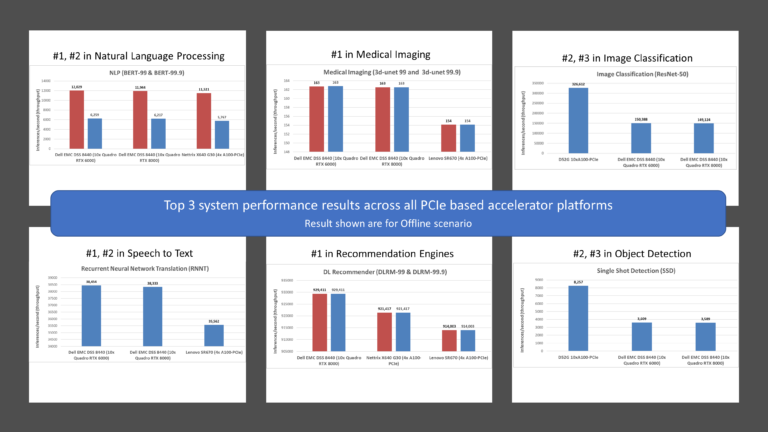
Dell EMC had a total of 210 submissions for MLPerf Inference v0.7 in the data center category using various Dell EMC platforms and accelerators from leading vendors. We achieved impressive results when compared to other submissions in the same class of platforms.  A few of the highlights is are captured below.

Dell EMC Study Material, Dell EMC Certifications, Dell EMC Guides, Dell EMC Prep

Dell EMC Study Material, Dell EMC Certifications, Dell EMC Guides, Dell EMC Prep

Dell EMC portfolio meets customers’ inference needs from on-premises to the edge


◉ Dell EMC is the only vendor with submissions on a variety of inference solutions – leveraging GPU, FPGA and CPUs in the datacenter/private cloud and Edge.

◉ Dell is also the only vendor to submit results on virtualized infrastructure with vCPUs and NVIDIA virtual GPUs (vGPU) on VMware vSphere. Datacenter operators can leverage virtualization benefits of cloning, vMotion, distributed resource scheduling, suspend/resume of VMs with NVIDIA vGPU technology for their accelerated AI workloads.

◉ The breadth of solutions and performance leadership across multiple categories make it crystal clear that we enable our customers to be on the fast track for their inference needs from on-premises datacenter to edge AI infrastructure.

We’re proud of what we’ve done, but it’s still all about helping customers adopt AI. By sharing our expertise and providing guidance on infrastructure for AI, Dell EMC helps customers become successful and get their use case into production.

Source: delltechnologies.com

Thursday, 24 September 2020

Benchmarking Machine Learning Performance at Dell Technologies

When it comes to training and inference workloads for machine learning models, performance is king. Faster system performance equates to faster time to results. But how do you objectively measure system ML training and inference performance? In a word, look to MLPerf.

MLPerf is a machine learning benchmark suite from the open source community that sets a new industry standard for benchmarking the performance of ML hardware, software and services. Launched in 2018 to standardize ML benchmarks, MLPerf includes suites for benchmarking both training and inference performance. The training benchmark suite measures how fast systems can train models to a target quality metric. Each training benchmark measures the time required to train a model on the specified dataset to achieve the specified quality target. Details of the datasets, benchmark quality targets and implementation models are displayed in the table below.

Dell EMC Study Materials, Dell EMC Certification, Dell EMC Prep

At Dell Technologies, we use MLPerf to measure the performance of our servers and storage systems running machine learning and deep learning workloads, particularly those in image classification, object detection, translation, natural language processing (NLP) and reinforcement learning.  Like many others in the industry, we leverage how MLPerf provides an objective way to measure and compare the performance of systems, including processors and accelerators.

To that end, we recently submitted benchmarks for the third version of the MLPerf training benchmark (v0.7), which attracted submissions from several new hardware vendors, resulting in results on a diverse set of hardware platforms. We participated in the closed division, which is intended to compare hardware platforms or software frameworks “apples-to-apples.” It requires the use of the same model and optimizer as the reference implementation.

The chart shows the increased participation in the MLPerf benchmarking competition since its start in 2018. The total number of submissions in the closed division doubled (2X) compared to the previous submission round (v0.6) and the number of submitters also increased by 3X compared to the first round (v0.5).

Dell EMC Study Materials, Dell EMC Certification, Dell EMC Prep

Out of the 130 submissions in the closed division, NVIDIA published the highest number of results, followed by Google and Dell — the Top 3 submitters.

Dell EMC Study Materials, Dell EMC Certification, Dell EMC Prep

Dell submitted results in 4 benchmarks, using two different ML frameworks (MXNet & PyTorch) and on two different Dell EMC server platforms. Dell was the only vendor to publish on PCIe GPUs, which is the widely used in many Enterprise organizations.

For this exercise, the engineers from the Dell EMC AI Innovation Labs, worked with NVIDIA to benchmark and optimize the performance of the Dell EMC DSS 8440 server with PCIe-based NVIDIA Tesla V100S GPUs and the Dell EMC PowerEdge C4140 server with NVIDIA Tesla V100 SXM2 GPUs and NVLink.

Among other outcomes, we showed that the DSS8440 server achieved particularly good results with the Resnet50 v1.5 and Mask R-CNN benchmarks, and we demonstrated that the PowerEdge C4140 server scales efficiently from one node to four nodes to train the models on 16 V100 GPUs.

The training times for Resnet50 v1.5 and Mask R-CNN are shown in the following figures.

Dell EMC Study Materials, Dell EMC Certification, Dell EMC Prep

Dell EMC Study Materials, Dell EMC Certification, Dell EMC Prep

Saturday, 15 August 2020

Reducing Wait Times With a New I/O Bottleneck Buster

Dell EMC Study Materials, Dell EMC Learning, Dell EMC Exam Prep, Dell EMC Guides

The Data Accelerator from Dell Technologies breaks through I/O bottlenecks that impede the performance of HPC workloads


In high performance computing, big advances in system architectures are seldom made by a single company working in isolation. To raise the system performance bar to a higher level, it typically takes a collaborative effort among technology companies, system builders and system users. And that’s what it took to develop the Data Accelerator (DAC) from Dell Technologies.

Dell EMC Study Materials, Dell EMC Learning, Dell EMC Exam Prep, Dell EMC Guides
This unique solution to a long-running I/O challenge was developed in a collaborative effort that drew on the expertise of HPC specialists from Dell Technologies, Intel, the University of Cambridge and StackHPC. The resulting solution, DAC, enables the next generation of data‑intensive workflows in HPC systems with an NVMe‑based storage solution that removes storage bottlenecks that slow system performance.

How so? DAC is designed to make optimal use of modern server NVMe fabric technologies to mitigate I/O‑related performance issues. To accelerate system performance, DAC proactively copies data from a cluster’s disk storage subsystem and pre-stages it on fast NVMe storage devices that can feed data to the application at a rate required for top performance. Even better, this unique architecture allows HPC administrators to leave data on cost-effective disk storage until it is required by an application, at which point the data is cached on the DAC nodes.

Plunge Frozen


Cryogenic Electron Microscopy (Cryo-EM) with Relion is one of the key applications for analyzing and processing these large data sets. Greater resolution brings challenges — as the volume of data ingest from such instruments increases dramatically, and the compute requirements for processing and analyzing this data explode.

The Relion refinement pipeline is an iterative process that performs multiple iterations over the same data to find the best structure. As the total volume of data can be tens of terabytes in size, this is beyond the memory capacity of almost all current-generation computers and thus, the data must be repeatedly read from the file system. The bottleneck in application performance moves to the I/O.

A recent challenging test case produced by Cambridge research staff has a size of 20TB. The I/O time for this test case on the Cumulus traditional Lustre file system versus the new NVMe DAC reduces I/O wait times from over an hour to just a couple of minutes.

Dell EMC Study Materials, Dell EMC Learning, Dell EMC Exam Prep, Dell EMC Guides
The Data Accelerator in the Cumulus supercomputer incorporates components from Dell Technologies, Intel and Cambridge University, along with an innovative orchestrator built by the University of Cambridge and StackHPC.

With its innovative features, DAC delivers one of the world’s fastest open‑source NVMe storage solutions. In fact, with the initial implementation of DAC, the Cumulus supercomputer at the University of Cambridge reached No. 1 in the June 2019 I/O-500 list. That means it debuted as the world’s fastest HPC storage system, nearly doubling the performance of the second‑place entry.

And here’s where this story gets even better. Today, Dell Technologies is sharing the goodness of DAC by making the solution available to the broad community of HPC users via an engineering-validated system configuration covering DAC server nodes, memory, networking, PCIe storage and NVMe storage.