Showing posts with label Pivotal Cloud Foundry. Show all posts

Thursday, 21 November 2019

Many Paths, Same Direction – Cloud-Native Adoption With Hyperconverged Infrastructure

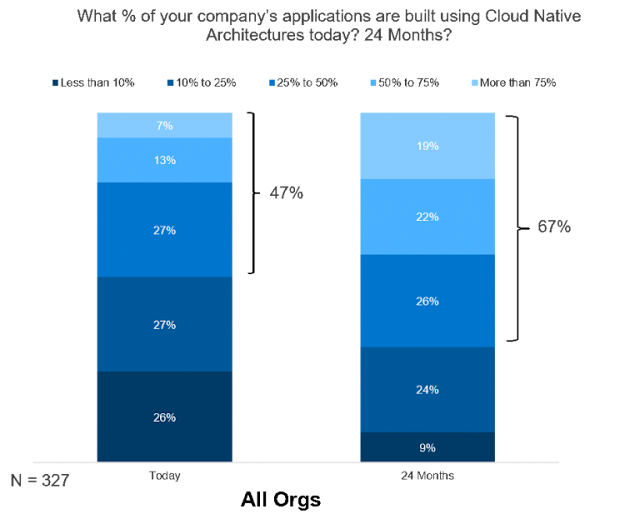
Innovation drives amazing changes in society, from self-driving cars to medicine that extends our lives. Innovation doesn’t happen in a bubble, however. It relies on human ingenuity, the right processes in place to remove obstacles, and technology which itself is a result of innovation. Businesses are looking for ways to drive innovation and beat out their competition. Which means going digital and adopting cloud-native applications and agility. In fact, based on our own research, in the next 24 months business adoption of cloud-native will jump to 67%, from 47% today.

Dell EMC Study Materials, Dell EMC Learning, Dell EMC Certifications, Dell EMC Learning, Dell EMC Online Exam

If adoption were so easy everyone would do it tomorrow, right? Well, there is a case for learning to walk before running with a staged migration, keeping legacy infrastructure and apps running alongside cloud-native apps. DevOps teams often cite the difficulties in managing the compute, networking, and storage resources of Kubernetes container orchestration in production, not to mention management of infrastructure, workload portability and securing the data wherever it resides. Yet, an overly cautious approach to cloud native might be too slow, and drive developers to find their own K8s dialtone to maintain the project velocity that they require; in this case, the effort to maintain stability creates a shadow IT problem that can lead to trouble later with cost or compliance issues.

The good news is there are many platforms and tools on the market to choose from that support cloud native operations. And more good news – Dell EMC hyperconverged infrastructure supports many of these platforms, with automated lifecycle management, consolidation of compute, storage and virtualization, and easy scalability. Dell EMC has engineered tested and validated HCI for Kubernetes solutions including VMware Cloud Foundation on VxRail, the foundation for the Dell Technologies Cloud Platform, which delivers a simple and direct path to the hybrid cloud with one, complete, automated platform. Automated PKS workload deployment and infrastructure supporting both legacy and cloud-native apps make VCF on VxRail truly transformational to a business. Additionally, businesses can choose from other HCI solutions supporting Pivotal Cloud Foundry with Pivotal Ready Architecture, for Azure Stack Hub with AKS, and Google Anthos on VxFlex.

Dell EMC Study Materials, Dell EMC Learning, Dell EMC Certifications, Dell EMC Learning, Dell EMC Online Exam

In addition, an expansive Dell Technologies portfolio provides best-in-class external storage, data protection solutions through PowerProtect for Kubernetes, and Consulting Services to help you at every step in the cloud-native adoption process.

And, for a true cloud experience within your modern data center, we offer Dell Tech on Demand delivering a wide range of flexible payment solutions and value-added services combined with integrated full-stack solutions to manage costs while not limiting your ability to meet changing resource demands of your app development teams.

Come visit us at KubeCon + CloudNativeCon in San Diego to learn how Dell Technologies can help you as a trusted partner and adviser. We remove the complexities associated with infrastructure resource management and help you focus on the high-value initiatives that matter. Together, we can Make IT Real.

Tuesday, 19 December 2017

Enterprise Integration Portal for One-Stop Tracking of Business Transactions

Tracking integrated business and service transactions across multiple IT systems is important in today’s fast-moving business climate. Being able to track them across two major IT companies (Dell and EMC) that recently merged to form Dell Technologies, one of the largest technology companies in the world, is absolutely vital.

That’s why Dell IT’s recent launch of a visualization tool that lets our business and IT teams use Dell technology to monitor transactions on a single dashboard is a critical step in the EMC/Dell integration.

It is called the Enterprise Integration and Services Business Monitoring Portal (EISBMP), a system that combines cutting-edge Dell technology solutions to bring together all integrated transaction data into a single view where business and support people can see transactions across multiple systems in a comprehensive dashboard.

Accessed via single sign on, the EISBMP has allowed us to consolidate more than 15 different tracking applications into one. It also lets us showcase our Pivotal platform and a range of other technologies across the powerful Dell portfolio that, combined with open-source apps, create this cloud native application.

The first phase of this project, which tracks legacy EMC transactions and serves internal IT customers, was launched in May and currently handles 20 million transactions a day. We plan to extend the portal to include legacy Dell over the next three to four quarters, expanding that volume to 120 million per day as our dashboard expands companywide. We also plan to open the EISBMP to our channel partners to allow business-to-business dashboard access in the near future.

The need for a single view

Like most growing organizations, EMC and Dell had amassed an array of systems and apps used to monitor transactions and support requests across various data bases. Our business and support users would have to check multiple locations to track a transaction from one phase to the next across our organization.

For example, prior to EISBMP, IT might get a call from a sales representative asking for insights into what is happening with a given sales order. Maybe they already confirmed the transaction data had been processed from the SAP database but didn’t know if it ever reached the third-party order fulfillment system we use to ensure our transactions conform to trade compliance regulations. Or they may be looking for its status in Salesforce.com, a third-party customer relationship management app we use.

There was no good portal that gave sales reps insight into what was happening with a given customer order to keep track of its movement across the many systems and tools.

With EISBMP, sales reps, as well as numerous other business users and support providers, can enter the transaction number to see where their customer order is within the business lifecycle.

Our new centralized dashboard tracks transactions for some 1,500 to 1,600 services that we support. And we expect to support another 3,500 services in the near future.

Dell EMC Guides, Dell EMC Tutorials and Materials, Dell EMC Guides, Dell EMC Learning

Bringing it all together

When EMC and Dell merged a year ago, the array of systems and platforms on which we processed business and support transactions became even more complex than the already complicated network of processes each individual company was grappling with.

Around that time, our Cloud Native Interactions (CNI) team, part of Dell IT’s Enterprise Integration Services, took on the job of creating a system that would integrate the various data sources and consolidate the various tools for the legacy EMC network.

Our task was to create a framework that would allow our various systems to work together, to connect to each other and exchange data and messages. The goal was to bring everything together in one dashboard.

We began by collaborating with business and support users to understand their needs and planning the high-level architecture we would need to build such capabilities. We then analyzed the kind of tools and technologies we would need to make it work.

My team decided to use Pivotal Spring Framework to build our portal. Not only did using Spring Framework fit into our practice of using our own technology, but it also provided an open-source product that is easy to use and offers standardization.

Technologies we chose include our own Pivotal Cloud Foundry and Pivotal Gemfire, Spring Boot and Spring Cloud Microservices.

The result is a single dashboard that is customizable and offers better insights into our integrated transaction data, which is also easily maintained. Users can search for transactions faster and see their status all in one place. Replacing 15+ apps with just ONE has resulted in significant cost and resource savings.

Dell EMC Guides, Dell EMC Tutorials and Materials, Dell EMC Guides, Dell EMC Learning

We are now working on completing the domain requirement to let our business partners access the EISBMP on a business-to-business basis. We are also working to extend the portal to integrate legacy Dell transaction data so that the dashboard will track transactions across the combined company. And eventually, we will offer mobile capabilities so that team members in the field can tap into such real time tracking information.

Overall, our new tool is enabling business and support teams to stay on top of their day-to-day transactions, track and address issues as they arise, analyze companywide metrics and leverage data to improve their performance and stay ahead of industry trends.