Saturday, 4 November 2023
Antarctica: An EarthX Film Festival Recap
Saturday, 1 April 2023
Increasing Ambition on our Path to Net Zero
Thursday, 22 December 2022
Improving Sustainability with AI and Making AI More Sustainable
Sustainability Use Cases for AI
Reducing the Energy Required to do AI
Saturday, 17 December 2022
Sustainability Doesn’t Need to Be Hard
It’s Time to Clean Out the Storage Closets
Don’t Let Shipping Materials Overwhelm You
Get the Most Use Out of Company Assets
A Better Way to Dispose of Devices
Sustainability Benefits Driven with Dell Services
Tuesday, 8 November 2022
Three Ways to Drive Down Data Center Energy Cost
Enable Power Management
Minimize Stranded Power
Eliminate Zombies and Ghosts
Saturday, 15 October 2022
Unlocking the Value in E-waste
Tuesday, 11 October 2022
Three Ways Dell Storage Advances Your Sustainability Ambitions
Energy Efficiency
Thermals and Cooling
Infrastructure Consolidation
Advancing Sustainability, Together
Wednesday, 28 September 2022
Empowering Partners to Sustainably, More Securely Retire Technology
Tuesday, 23 August 2022
Managing E-waste Responsibly: Critical Steps Towards a Circular Economy
E-waste not only poses health and environmental hazards, it’s also an untapped value that businesses of all sizes, across all sectors, could return to the circular economy.
According to the Global E-waste Monitor 2020, only 17.4 percent of e-waste is formally documented as being collected and recycled. The report estimates that globally, e-waste will reach 74 metric tons by 2030, nearly double the amount since 2014. According to UNESCAP, Asia generated the greatest volume of e-waste in 2019 — some 24.9 metric tons, followed by the Americas (13.1 mt) and Europe (12 mt), while Africa and Oceania generated 2.9 mt and 0.7 mt respectively.
The rapidly increasing rate is another concern for planning future e-waste management. The annual growth rate of e-waste was estimated to be 3-5%, which is about three times larger than other types of waste.
Good for Bottom Line, Better for Environment
The business case to protect our planet couldn’t be more evident. The global IT asset disposition market size was valued at 18.57 million USD in 2021. It is expected to increase to 51.38 million USD by 2030 at a CAGR of 12% during the forecast period of 2022–2030. The Asia Pacific market is projected to account for 25.44 USD million by 2030, expanding at a CAGR of 14%.
The same Global E-waste Monitor 2020 report also addresses financial implications. The report shows that the amount of iron, copper, gold and other minerals discarded in e-waste is valued at over 57 billion USD. Recovering those materials through proper recycling benefits the planet and businesses.
Start to Adopt Circular IT Strategies to Extend Product Life Cycles
Accelerating the circular economy is at the core of Dell Technologies Environmental, Social and Governance (ESG) goals. By moving away from the linear economy and embracing a circular one, we can design to reduce and reuse waste, and extend the useful life of products and materials to reduce environmental impact. At Dell, we believe technology will play a key role in this shift, and we see the circular economy as a critical business model for our collective future. As a global technology leader, we have a strong opportunity to minimize waste and as a result, emissions by driving circularity through everything we do.
When a product reaches its end of life, the materials can be reused and recycled, creating sustainable value within the circular economy. Supporting this model reduces environmental impact while giving businesses opportunities to increase competitiveness, stimulate innovation and revenue, reduce operating costs and create jobs.
We are also walking the talk. Since 1996, Dell has been offering secure recovery solutions for customers around the world. Since 2007, we have recovered more than 2.6 billion pounds (1.2 billion kilograms) of used electronics. Asset Recovery Services, for example, helps businesses securely and responsibly retire their IT equipment. Earlier this year, Dell expanded its support for Asset Recovery Services, which is now available in 36 countries.
Retire your IT Equipment Securely and Sustainably with Asset Recovery Services
When selecting a partner to help reduce your organization’s environmental impact and improve your sustainability practices, consider Dell’s Asset Recovery Services. By leveraging Dell’s long-standing security expertise and commitment to sustainability, you can responsibly resell, recycle or return to lease your legacy IT equipment and shift your focus to what’s next.
Here’s how it works:
◉ Return any brand. We’ll take back all of your owned or leased hardware, no matter where it came from.
◉ Leave the logistics to us. We’ll handle every detail from pick up to final reporting, so you can stay focused on your core business.
◉ Keep your data safe. We’ll sanitize devices in strict alignment with the NIST SP 800-88r1 standard to ensure data doesn’t fall into the wrong hands.
◉ Unlock value. Your aging asset may have more value than you think. Our goal is always to reuse, extending the life of the product as our first priority. We’ll resell your equipment and send the money back to you.
◉ Protect the planet. If your asset has no value, we’ll dispose of it in compliance with local regulatory guidelines.
◉ Peace of mind, on-demand. Customize and download status reports to keep track of your services from anywhere. Data sanitization, confirmation of disposal, and resell/recycle reports are at your fingertips.
Source: dell.com
Thursday, 7 April 2022
Secure and Responsible Retirement of IT Equipment Made Easy
As your company refreshes information technology to stay competitive and keep employees productive, you’re likely asking yourself lots of critical questions about your aging IT equipment, like:
Retire now versus later to maximize value for your business and the planet
Keeping your data safe is our number one priority
Help create sustainable value
How Asset Recovery Services works
Dell: Your asset recovery partner
Wednesday, 23 March 2022
Rethinking Recycling
Did you know the estimated amount of worldwide e-waste in 2021 outweighed the Great Wall of China? Alarming statistic, right? These are the types of data points that inspire me to continue to create programs that move people from passive concern to taking action to improve our planet.
What motivates people to make recycling an important part of owning technology? To find out, we regularly conduct research, host focus groups and proactively seek out input from our business customers. What they consistently tell us is that recycling needs to be easier and fit into their regular routines, and for businesses, data security is one of their top concerns. We use these insights to improve our services to take back technology with the goal of extending the life of those products and materials through repair, reuse and recycling.
Since 2007, Dell has recovered more than 2.5 billion pounds (1.1 billion kilograms) of used electronics, but we know we must be even more aggressive to deliver the positive environmental impact that will result from reusing and recycling one product for every one sold by 2030. To achieve this ambitious goal, we are building on our more than 25 years of experience in global recycling services to rethink and redesign our approach.
Here are a few recent examples of how we are using insights and testing out new ideas to ultimately increase recycling:
◉ Commercial customers represent the most significant opportunity to scale taking back out-of-use and legacy equipment. This month we’re expanding our Asset Recovery Service to 36 countries globally. With this service, Dell manages the pickup logistics of any brand of leased or owned hardware, sanitizes used devices to ensure data doesn’t fall into the wrong hands, resells devices to give value back to the customer or recycles the equipment responsibly and provides a comprehensive report of the process, including the ability to manage and follow the entire process through our online TechDirect portal.
◉ To get consumers to send in out-of-use technology, we are giving them something back. With Dell Trade In, U.S. consumers can register eligible personal electronics – of any brand, in any condition – for instant credit. A completely free service, consumers simply enter the details of their eligible device online, receive a quote for the credit they will receive and drop it off at a FedEx location or drop box. As soon as the box is scanned, the value is instantly emailed to the customer in a virtual pre-paid debit card that can be used to purchase Dell products and services.
◉ Last month, Dell Technologies was excited to join Google, Apple, Amazon and Microsoft to launch a year-long, city-wide collect-from-your-door electronics recycling pilot for consumers in Denver, Colorado. A technology industry-first collaboration developed in partnership with recycling start-up Retrievr, this pilot will collect insights to better understand the most critical factors affecting consumer behavior and apply them to improve processes for recycling electronic waste. Denver residents can find out more about how to use this service here.
If we want to make a dent in that Great Wall of China sized mountain of e-waste, we have to dramatically scale recycling. This is why, for the month of April leading up to Earth Day, Dell Technologies will launch an awareness campaign to get people to participate in a “Global Recycling Drive for the Planet.” Designed to share the impact of e-waste and inspire action, we aim to mobilize our global community of team members, consumers, customers and partners to move the needle on extending the life of out-of-use technology – not only in the lead up to Earth Day – but year-round. Together we can dramatically decrease e-waste and protect the planet for the future. To learn and participate today, please visit DellTechnologies.com/Recycle.
Source: dell.com
Friday, 11 February 2022
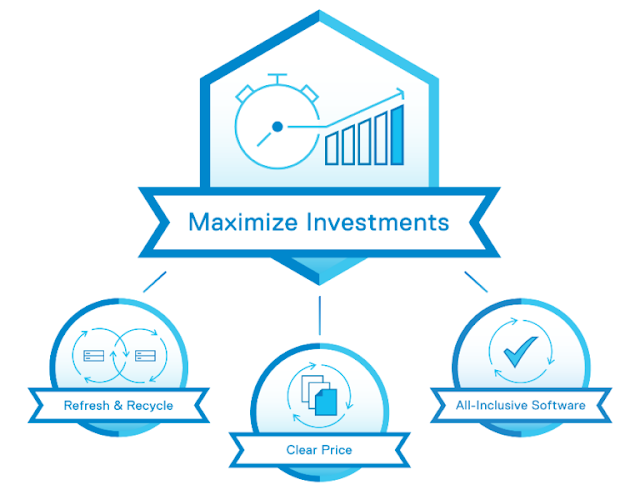
Dell Technologies Future-Proof Program: Maximize Investments
Dell Technologies Future-Proof Program is designed to simplify the IT decision-making and purchasing process for data center managers. IT managers and administrators must evaluate numerous factors when making IT decisions and partnering with Dell Technologies simplifies the process.
The Future-Proof Program is divided into three different high-level pillars which are: Guarantee Outcomes, Maximize Investments, and Navigate IT Futures.
Tech Refresh & Recycle
Clear Price
All-Inclusive Software
Tuesday, 5 October 2021
Build a Sustainable Future by Supporting the Circular Economy
Sustainability discussions have been front and center for government and industry leaders worldwide. There has been much talk about reducing e-waste and the impact it has on the environment. Globally, the world generated 53.6 million metric tons of e-waste in 2019 and that number is expected to grow to 74.7 million metric tons by 2030. This is fueled by the growing market for all kinds of electronics with limited participation in formal recycling and reuse programs. In simple terms, the world is still too focused on consuming and throwing away.
Read More: DES-5221: Dell EMC Data Center Networking Specialist Exam for Implementation Engineer
The embracing of sustainable practices in IT among businesses has been slow. Most do not have an environmentally sustainable process in place for disposing of IT equipment. Greater importance must be placed on making a difference and changing the trajectory. Opportunities continue to exist to become more efficient at managing IT infrastructure lifecycle and e-waste management.
In many locations around the world, policies and regulatory requirements govern how end users are supposed to dispose of their equipment in order to help keep this equipment out of landfills when the electronics reach end of life. The question is, how can a customer address this e-waste issue while fulfilling business and operational goals? The circular economy is one of the key initiatives of sustainability to drive change.
As part of sustainability initiatives, IT leadership will need to consider the impact of e-waste arising from their infrastructure environment going forward. It’s not just a trend but a necessity.
Circular Economy
A circular economy gives us the tool to tackle resource use, climate change and biodiversity loss while addressing important social needs by repairing, refurbishing, reintroducing, remanufacturing or recycling products, keeping them in the economy. The goal is to have very little to no waste. Traditional economic approach is linear, beginning from natural resource to final product and ultimately disposal. Extending the life of electronic products and re-using components benefits the economy by generating less CO2 emission compared to mining for raw materials or manufacturing. Functioning equipment is valued more than the materials they contain. E-waste no longer becomes a waste or pollutant when it is put back into the economy in a useful format.
Commitment to Sustainability
Dell Technologies has a longstanding commitment to sustainability. We have a corporate goal that, by 2030, for every product a customer receives, we will reuse or recycle an equivalent product. We have an additional goal to make more than half of our product content and all of our packaging from recycled or renewable materials, thus helping close the loop. In conjunction with our other Progress Made Real goals, we are trying to drive sustainability and accelerate the adoption of a circular economy. Circularity is a key component of our design standards and we can see Circularity at work throughout Dell’s product lifecycle.
Technology Rotation
How can you advance sustainability and participate in the circular economy? Technology Rotation* integrates payment solutions into the procurement strategy, contributing towards the U.N.’s Sustainable Development Goals (SDGs), lowering total cost of ownership, and creating a positive impact on the environment.**
Technology Rotation optimizes the technology lifecycle by rotating in the latest products at a pre-defined cycle without continuing to incur cost for technology that is no longer operating at its peak performance. Technology Rotation contributes to the Circular Economy by refurbishing and remarketing 95% of assets. The recirculated equipment is therefore put back in to productive use. The remaining 5% are recycled in adherence with local regulatory guidelines such as EPA in the United States, WEEE in Europe, and NCTRS in Australia.Increases in business flexibility of Technology Rotation allows companies the ability to innovate and meet challenges from new initiatives. Acquisition of technology is simplified. The findings from IDC Survey demonstrates that it can lower your Total Cost of Usage (TCU) by up to 33%. Technology Rotation improves operational efficiency. Systems and applications running on the latest technology achieve higher performance with less resource consumption. And of course, at the end of the cycle, we take that equipment back for reuse or recycling.
Sustainability Partnership
Dell Technologies can partner with you to meet your sustainability goals in reducing e-waste with Technology Rotation. The benefits are optimized performance, getting the latest equipment technology and moving the responsibility of handling e-waste to us. Together we can build a better world and a sustainable future.
*All websites referenced in this article are intended for readers located in the United States only. Readers outside of the United States may access their county’s website by selecting their location from the location menu. Products and offers may not be available or may vary by country.
**Payment solutions provided and serviced by Dell Financial Services L.L.C. or its affiliate or designee (“DFS”) for qualified customers. Offers may not be available or may vary in certain countries. Where available offers may be changed without notice and are subject to product availability, applicable law, credit approval, documentation provided by and acceptable to DFS and may be subject to minimum transaction size. Offers not available for personal, family or household use. Dell Technologies and the Dell EMC logo are trademarks of Dell Inc. Restrictions and additional requirements may apply to transactions with governmental or public entities. FAIR MARKET VALUE (“FMV”) LEASE: At the end of the initial FMV Lease term, lessee may 1) purchase the equipment for the then FMV, 2) renew the lease or 3) return the equipment to DFS
Source: delltechnologies.com